• Skip to main content
  • Skip to primary sidebar

The Mija Chronicles

Mexican food and culture, on both sides of the border

tamales

My favorite food moments of 2012

December 31, 2012 by Lesley Tellez

A tlayoyo — a rustic Poblano version of the DF tlacoyo, made with mashed alberjón beans and avocado leaves — was one of my favorite foods of 2012.

I’m grateful for so many things this year.

We saw a little bit more of the world. We had lively conversations with good friends and stared out at gorgeous vistas and sipped excellent wine. (And excellent mezcal.) I got to come back to a city that I love like no place else — fetid air, crushing traffic, raw chicken vendors who hoot at me and all — and I got to learn and share everything I know about Mexican food, a job that I still cannot believe is mine.

My family, thankfully, stayed healthy, and my husband did not complain when I had to work weekends, on vacation, or until 9 p.m. on a weeknight. (Thank you honey, and I promise not to make you visit any more markets if you don’t want to.) I’m also thankful for the vendors who said hi to me when I was walking down the street, and for the stoic tlacoyo lady who prepared her last tlacoyo of the day for me, for free — “Un regalo de navidad,” she said. I’m thankful for the roof over our head and the abundance of food in our lives.

I really don’t know how I ended up with this life, but I am so glad it’s mine.

Here are some of my favorite food moments of the year:

1. The Tamales Course at Fundación Herdez. This four-day course was probably the best cooking class I’ve ever taken in Mexico City. The instructor gave an exhausting overview of tamales from prehispanic times to the present, and we supplemented our knowledge with a trip to the Botanic Garden at UNAM.

Grilled tamales at the Fundación Herdez cooking course in January, 2012

The filling for a grilled tamal: one small mojarra fish, a leaf of purple epazote, tomatillos and xoconostle slices.

2. Judging a small-town tamale fair. We arrived to Tetepango, Hidalgo thinking we’d peruse the tamales and atoles and that would be that. Instead we ended up judging more than 100 homemade tamales and atoles, in flavors like cajeta con whisky and bean maguey-worm. It was a blast.

A “tamalchil” — tamal with chile ancho — at the Tamales & Atoles Fair in Tetepango, Hidalgo.

Ben and I deep in thought. Was the masa too dry? Too dense? These were the questions we grappled with.

3. Making homemade tortillas at the Escuela de Gastronomía Mexicana. This was my second-favorite cooking class of the year. We made tortillas with guajillo chiles, and tortillas embedded with quelites. Mine inflated (ya me puedo casar), and I realized that a huge part of making good tortillas is a hot comal. I’m blaming my non-inflated tortilla failures at home on my stupid electric stove.

Homemade tortillas with quelites and guajillo chiles at the Escuela de Gastronomía Mexicana

4. Visiting the farmers of Xochimilco. I’d heard of De La Chinampa, a group that supplies organic, locally grown produce to restaurants and local residents in Mexico City. In March, I finally had a chance to see the chinampas up close during a trip with Ricardo Rodriguez, the organization’s director. We met a farmer, who explained his farming practices to us; then we floated around the most tranquil part of Xochimilco that I’ve seen.

Cilantro seedings, farmed in the chinampas of Xochimilco

The Xochimilco canals at sunset

5. Touring Queens with Madhur Jaffrey. In April, I was one of the few lucky ones who got to take an Indian food tour of Queens with Madhur Jaffrey, part of an event with the International Association of Culinary Professionals. Ms. Jaffrey was gracious and kind, and she taught us the history and preparation of every food we tried. This ranks in my top food experiences ever.

One of my favorite things was chaat, a cold-spicy-sour-sweet salad that’s eaten as a snack.

6. Puebla’s International Mole Festival. In May I tasted some of the best foods in the state of Puebla — moles, molotes, tlayoyos and more — and listened to Rick Bayless, Marcela Valladolid, Mark Bittman and others share their personal experiences with mole and Mexican food. Completely worth the journey there and back, and I’m already looking forward to the festival again next year.

Spooning chilayo onto a molote. Chilayo is made with sesame seeds, white beans and red jalapeños.

7.The joy of Oaxacan tamales. I thought I had tasted tamales before I went to Oaxaca. Let’s be clear: I had not tasted tamales. These tamales have ruined me on all other tamales, now and into the future. Every time I make tamales, I know they will not be as good as the Oaxacan ones, and that is the cross I have to bear.

A bean tamal with hoja santa in Etla, Oaxaca

8. Burning a tortilla on an outdoor stove, for homemade mole. During the same June trip to Oaxaca, I took a cooking class with Susana Trilling. I volunteered to make the chichilo mole (no one else wanted to do it), which entailed burning a whole tortilla on the clay comal and then adding the ash to the stew. Can I tell you how fun this was?

Burning a tortilla for chichilo mole

The tortilla’s on fire, the tortilla’s on fire!

9. Roast suckling pig in Mealhada, Portugal. When we were in Portugal in July, Crayton insisted (yes, Crayton!) on taking a side trip to Mealhada, also known as roast suckling pig central. We got lost on the way there, so we had to pull over and ask for directions in Crayton’s Brazilian-style Portuguese. Eventually we found Pedro Dos Leitoes, a huge restaurant with skewers of pigs roasting in the front lobby. We gobbled down an entire lechón with the crispest skin, plus potato chips, salad, bread, olives and dry, fizzy white wine.

Lechón (roast suckling pig) at Pedro dos Leitoes in Mealhada, Portugal

10. A long weekend in Coatzacoalcos, Veracruz. So what if the city is feíto? The food is fantastic, and I’d love to go back. I had the best time touring the markets with my friend Janneth and her mom, Martha. We stopped at little restaurants and I helped make homemade tamales de masa colada.

Camarones enchipotlados (shrimp in chipotle sauce) outside Coatzacoalcos, Veracruz

11. A food tour of Tijuana. I’m going to write about this soon — hey, it barely happened in October (wince) — but Crayton and I had the pleasure of taking a food tour with Bill Esparza, a blogger and Mexican food expert who lives in LA. Of the places he showed us, my favorite was Mariscos Ruben. The goopy, creamy taco de marlin still lives on in my dreams.

A taco de marlin from Mariscos Ruben in Tijuana, Mexico

12. My first homemade chile en nogada. In hopes of channeling the 19th-century Poblana nuns who invented this dish, I went to Puebla to buy my ingredients and I peeled walnuts for six hours. When it came time to fry the chiles, curls of smoke wafted out of my kitchen and floated over my guests’ heads. In the end — the chile was spectacular.

I forgot one more thing that I’m thankful for: you reading this blog, and commenting (or not), and generally making The Mija Chronicles a lovely place to be. I wish you a wonderful New Year, and hope you get a few moments of reflection before all the craziness begins.

Un abrazote a todos!

Filed Under: Reflections, Streets & Markets Tagged With: Oaxaca, Puebla, tacos, tamales, Veracruz

Felices fiestas!

December 24, 2012 by Lesley Tellez

I hope you’re enjoying a lovely day with family, friends and lots of good food.

Here are a few Christmas-inspired photos culled from The Mija Chronicles’ archives.

A big ol’ pot of bacalao, at Mercado de Medellín

My Christmas ponche recipe

Ensalada Nochebuena, a mix of beets, oranges, jicama and peanuts

First-ever Christmas tamalada, December 2009.

Sweet corn tamales

Strawberry tamales

Pumpkin and chorizo tamales

Bean tamales at the Fundación Hérdez in January 2012.

Chaya-wrapped tamales, at the Fundación Hérdez in January 2012.

Squash flower and chepil tamales, Etla, Oaxaca

Filed Under: Reflections Tagged With: Christmas, mercados, Photography, tamales

The foods of Southern Veracruz

November 8, 2012 by Lesley Tellez

A memela at Tio Chon, a restaurant outside Coatzacoalcos, Veracruz.

Janneth and I had talked about me visiting her in Coatzacoalcos for months, ever since she came back from Coatza one day and started telling me about all the things she saw there that didn’t exist in Mexico City — tubs of small freshwater fish, crackery tortillas, and puffy, airy quesadillas called empanadas, which were served covered in shredded cabbage. Crayton and I finally had some free days in September so we decided to take a long weekend.

An aeiral view of Coatza from Mexico PostCode.

Coazta isn’t usually where folks stop in Veracruz. It’s an oil town along the state’s southern edge, and nobody really goes there unless they work for Pemex or they know someone who works for Pemex. There is a beach but no one swims in it. One person commented on my Instagram feed that I should visit other cities in Veracruz, because Coatza was bastante “feíto.” (Ugly.)

Coatza has nothing in the way of cool architecture or museums — a reviewer on Trip Advisor called their Museum of Olmec Culture “a pirated version of Epcot Center” — but it’s got good food, which makes it a perfectly reasonable destination in my eyes. After this trip I’m more convinced than ever that good food can be found anywhere in Mexico, even the most feíto towns.

The best of Coatza: gorditas and markets

Janneth grew up in Coatzacoalcos (her dad retired from Pemex), and she graciously offered to not only drive, but let us stay at her parents’ house. Our first morning there we drove to La Picadita Jarocha for breakfast, a bustling cafe open to the street. She insisted we try the balloony sweet gorditas, made with masa speckled with anise seeds and stuffed with mole. They arrived liked little bubbles, and then we cut them open to reveal the mole underneath. I cannot tell you how good these things were.

Look at that mole peeking out from inside. It wants you.

Afterward we wandered around Coatza’s market with Janneth’s mother Martha, a wonderful cook and local food expert. She pointed out more things I’d never seen: black camarones reculones, called as such because they walk backward; little nubs of homemade achiote paste, and hoja blanca leaves used to wrap tamales.

She also showed me the cracker-like totopos that came from the Isthmus of Tehuantepec, where she’s from. I’d seen them before outside the 20 de Noviembre Market in Oaxaca, but they seemed to be more prolific here.

Lisa seca, a dried salted fish from the Isthmus of Tehuantepec. Martha said you have to soak it in water several times to remove the salt, then squeeze on lime juice, chopped tomatoes, onion and cilantro. Then you grill it.

Oreganón, an intensely aromatic oregano.

Fresh camarones reculones, AKA “shrimp that move backwards.”

Fresh Mexican blue crab, known as jaiba.

Homemade achiote paste. This is not what you find in the supermarkets in Mexico City — it contains nothing except ground achiote seed and water, cooked in a kettle until concentrated.

Then we made a quick stop at Janneth’s aunt’s restaurant to watch the staff make tamales de masa colada. I’d never actually seen masa colada up close — it’s a tamal dough made from nixtamalized corn that’s cooked almost to a Cream-of-Wheat consistency.

A team of two women worked fast on the back patio, laying down an hoja blanca leaf, a banana leaf, a heaping spoonful of masa colada and then chicken, epazote and red chile sauce. Then they wrapped everything neatly and tying the tamal with a little knot. I tried to make one and the sauce oozed out one end.

Pretty little tamales.

We ended the day at an open-air restaurant with a dirt floor called Tio Chon, located off the old two-lane road to Minatitlán. Janneth instructed us on the proper Coatzacoalcosian way to eat camarones enchipotlados — place the whole shrimp in your mouth, suck off the sauce, then dip it in more sauce when no one is looking. (Her mom immediately told us, don’t do it that way, she’s wrong.)

Just seeing this photo now makes me want to suck off all the chipotle sauce.

I’m calling this a mole sundae: rice topped with fried plantain, egg and rich Veracruzan mole.

The Minatitlán market

Crayton was not exactly enthused to visit another market, but he was powerless against the trio of Janneth, Martha and I, who could together probably spend eight hours talking to vendors and scribbling down recipe notes. We visited another market — the Mercado Popular Campesino — in Minatitlán, a small town about 20 minutes from Coatzacoalcos.

The heat was stifling even at 10 a.m. Ladies in checkered smocks, their faces shiny with sweat, sold various vines and fruits and vegetables, some of which I hadn’t seen at the Coazta market the day before. We tried pópo, a beverage made from toasted cacao beans, rice, cinnamon and a vine called asquiote. One vendor was selling asquiote, too, which excited all of us to no end.

“Look, it’s asquiote!” I told Crayton. He just looked at me and continued checking his Blackberry.

I loved the tortillas de frijol, a crispy plate of a tortilla — sort of like a tlayuda — made from masa mixed with beans. Martha said you eat it with cheese and very hot salsa. I bought one and munched on it while we shopped.

Asquiote, which is chopped and ground and used in the beverage pópo, in Southern Veracruz

A jicara full of pópo, a beverage made from toasted cacao beans, rice, cinnamon, anise seed and asquiote.

This is the tricked-out molinillo — made by hand — used to aerate the pópo, which traditionally is served with a thick layer of foam on top.

Our Minatitlán breakfast. They were out of pejelagarto tamales.

Chile chilpaya, sort of like piquín but rounder and slightly longer.

There was one more food-related activity — hunting down the famous carne de Chinameca — but I’ll save that for the next post.

After only a few days together, I told Janneth and Martha that we should plan another trip together, to Martha’s hometown in the Isthmus of Tehuantepec in 2013. If we do go… sorry Crayton, you’re not coming.

Filed Under: Streets & Markets, Travel Tagged With: tamales, Veracruz

Where to eat in Mexico City: Café de Raíz

May 18, 2012 by Lesley Tellez

Some of my favorite tamales in the city are sold at Café de Raíz, a tiny Roma café near the Plaza Luis Cabrera.

Owners Pola Carballo and her brother Mardonio Carballo offer a handful of varities daily, and they’re much better than what you usually find on the street or in cafés here. The tamal de arroz — made with actual rice grains, not rice flour — is almost like a comida corrida on a plate, with a thick layer of rice snuggled around a stripe of sweet-and-savory chicken picadillo filling.

The tamal de frijol is one of the best I’ve had anywhere in Mexico. A moist rectangle stuffed into a banana leaf, the tamal emits a heady herbal perfume that pretty much bewitches you into eating more. Pola says it’s a mix of masa, black beans, cilantro, oregano and “un toque de manteca.”

The cafe carries between four or five varieties of tamales daily, with the rice and bean varieties pretty much constant. They also sell atoles (seasonal flavors include guava, pineapple, tamarind, champurrado) and pozole on the weekends. And there’s a breakfast menu. I loved the huevos rancheros, a rustic style with chunky tomato sauce on crispy corn tortillas.

The Carballos are Nahua people from Veracruz. Mardonio is also a journalist and writer, and he hosts a TV show on Mexico City’s Channel 22 called De Raíz Luna, which explores indigenous themes.

Pola says the cafe is meant to be a tribute to corn, and you can really taste the love in the dishes. If you like tamales — or even if you’re so-so about them — this place is worth a visit.

Café de Raíz
Merida 132 Bis between Chihuahua and Guanajuato streets, Colonia Roma
Open daily from 9ish a.m. to 10 p.m., and there’s WiFi.
tel. 5584 8847
No website, but they’re on Twitter

Filed Under: Restaurant reviews Tagged With: tamales

Travels through small-town Mexico: Tamales & atole in Tetepango, Hidalgo

March 5, 2012 by Lesley Tellez

A tamalchil, or tamal topped with an ancho chile and steamed.

A few months ago, my friend Ruth forwarded me an email about a tamales and atole fair in Tetepango, Hidalgo. The email was scarce on details, but it did contain one important fact: there would be more than 100 varieties of tamales and atoles for sale. More than 100. The organizers were also offering a free hotel stay for any DF foodies on the email list.

This was not a hard decision for me to make, although I don’t have a car and had no idea where Tetepango was. Free stay? A hundred tamales? I’m in.

Arriving to the tamales & atoles fair

After securing driving directions, I set off with Crayton, my friend Ben and his partner John in a rental car one Saturday afternoon. We arrived to Tetepango, a small town just past Tlaxcoapan (so you have a reference point), to find a party that had pretty much taken over the square. A live band blared cumbia. Hundreds of people milled underneath a huge tent, many of them wearing cowboy hats. I was expecting a series of stands along a street, but this looked like the event of the year.

We quickly set to work trying as many things as we could: atole de xoconostle con manzana (a tart, warm apple drink); red-wine flavored atole, coconut atole. We tried a tamalchil, which was a tamal topped with an ancho chile. We tried pork with peas in tomatillo sauce, tamales de quelites and a fabulous bean tamal wrapped in a banana leaf.

In front of one atole stand, a teenager shouted out all the varieties, urging people to stop and taste. “Atole! Atole de manzana! Pásale!”

There were a lot of atoles.

Atole varieties

Just when we thought we’d eaten enough tamales…

Right as we were getting full, I called my contact, Jair, the director at a local cooking school, to see if there was anything he recommended we try. His wife answered his phone and said, “Come on stage.” (Yes, there was a stage.)

The four of us trooped up and made introductions. Then Jair motioned to a nearby table and told us to sit down. The festival included a contest, so about eight people in chefs’ jackets nibbled on tamales and sipped atole, scribbling notes on scorecards. “Go ahead, integrate yourselves,” Jair said. Wait — he wanted us to judge?

Crayton bowed out and so did John. I’m sure my eyes must have lit up, because these are the kind of tasks I was born for. This might have been the reason why I specifically chose a loose-fitting shirt.

Over the next 2 1/2 hours, Ben and I ate and ate. Corn husks piled up on top of each other, cold crumbs of masa inside. Jarritos containing our tastes of atole squeezed together in any open spot on the table.

I tried to judge the best I could, but to be honest, there were simply too many tamales and atoles moving too fast. They came at me from both sides of the table, about one every 30 seconds.

Crayton caught a blurry picture of us judging from afar. You’ll notice Ben and I deep in concentration.

Once we were done, and my stomach had sufficiently stretched the waistband of my jeans, it was time for the prizes. Tetepango knows how to throw a big event, so the prizes were enviable — a flat screen TV, an electric mixer, a set of glass casserole dishes.

The winners, announced with fanfare, were the tamales de pulpo with tomatoes; tamales de cueritos and, in first place, tamales de frijol con salsa de chinicuiles.

On the atole side, the winners were red wine atole and atole de cajeta con whisky.

After the festival was over the organizers were kind enough to show us our hotel, located next to a balneario. I think I might have dreamed of tamales on a conveyor belt.

The next morning another festival organizer, Amalia Rufina Neri Ángeles, had arranged for us to have breakfast with a local gastronomy student and guide, Marco Ramirez. We headed for the Sunday tianguis in Tlaxcoapan for barbacoa.

Well, first I asked Marco if we could stop for pandulce, and then try barbacoa.

Fresh bread sold at a roadside convenience store and bakery in Tetepango, Hidalgo

This is the breadmaker.

Salsa for sale at the Sunday tianguis in Tlaxcoapan, Hidalgo

Moronga, or blood sausage, at a barbacoa stand in Tlaxcoapan

A chunk of barbacoa, before serving.

Hidalgo barbacoa

A kilo of barbacoa, which we barely made a dent in. (Took the rest home.)

After we ate, we wandered around and took more pictures. I bought some gorgeous beans I’d never seen before, which the vendor told me were called San Franciscanos, grown locally in Hidalgo.

San Franciscano beans

Fresh corn for tortillas

A bucket of fresh, nixtamalized corn, bound for the local molino

Inflated tortilla

A perfectly inflated tortilla.

Amalia and Marco, who were both so gracious and generous with their time, told us there were dozens of festivals in that part of Hidalgo every year, including ferias de barbacoa and barro. I’d really like to go back.

Filed Under: Travel Tagged With: atole, Hidalgo, tamales

Five truths about tamales

February 2, 2012 by Lesley Tellez

A masa-free tamal, made with mojarra, tomatillos, xoconostle and epazote

The more I learn about Mexican food, the more I realize I’ll never know enough.

So many things just simply aren’t written down: recipes, techniques, the names of regional chiles from tiny villages. Really learning this cuisine means traveling to cities and towns and tasting as many things as possible. Or at least studying with people who have.

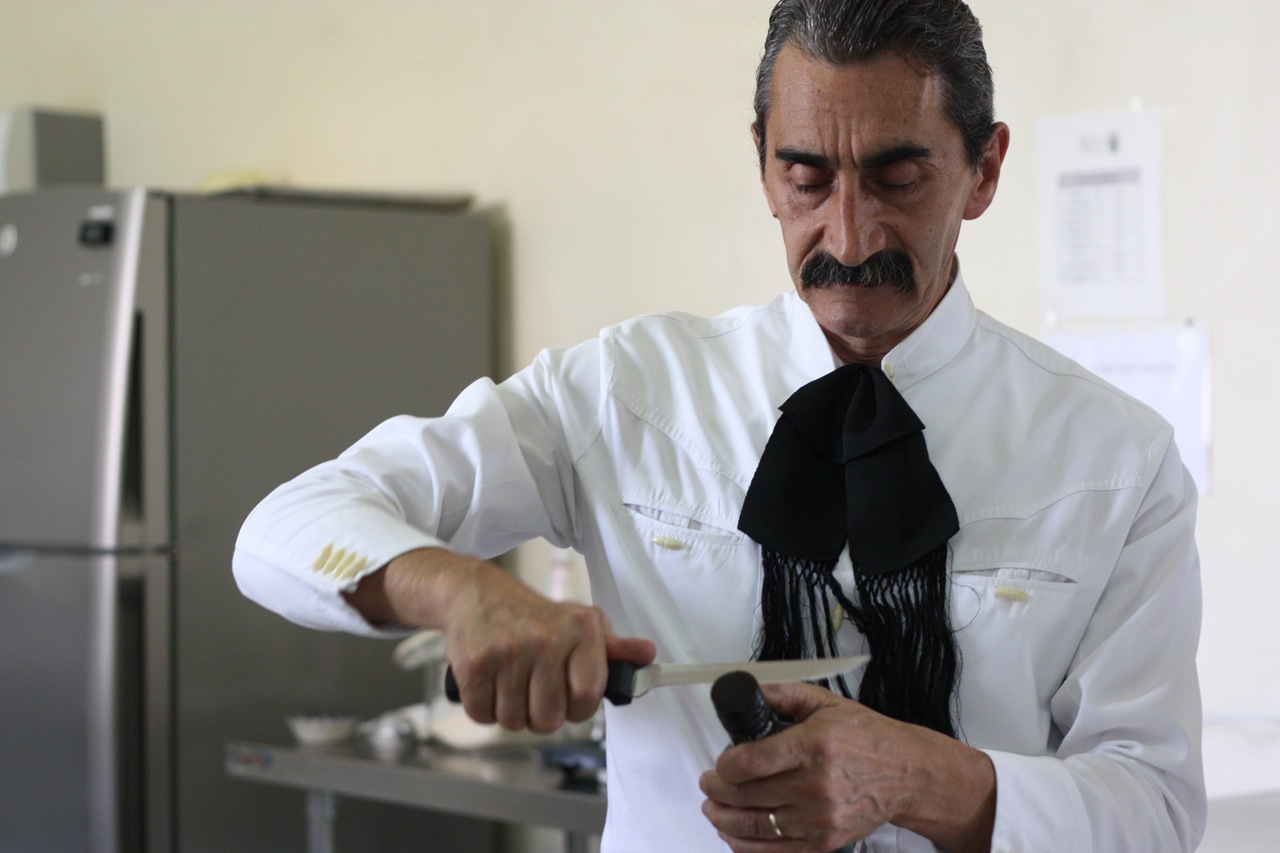
This is why I was so excited to take a four-day prehispanic tamales cooking course at the Fundación Herdez last week. The course would be taught by Raúl Traslosheros, a chef who has researched tamales in cities and villages across Mexico, and writes about Mexican culinary culture for the magazine Sabor a México. The course also included a guided visit to UNAM’s Jardín Botánico, led by two UNAM scientists (I’d probably call them ethnobiologists): Drs. Robert Bye and Edelmira Linares.

After four days — and the fantastic visit to the Jardín Botánico, where I’d never been — I ended up learning more than I could have hoped. I was literally on a tamal-high, wanting to shout at everyone, “My eyes have been opened!”

Here’s a list of five things I learned in the class. If you’re planning to make tamales for Día de Candelaria, which is today, this might be helpful for you. (For more on what tamales have to do with Día de la Candelaria, here’s my post on strawberry tamales from last year.)

Five Truths About Tamales

Tamales at the Fundación Herdez

Beating the masa in a KitchenAid mixer.

1. The perfect tamal starts with the masa. Of course the fillings matter too, but the most margin for error lies in the dough. If your masa isn’t adequately hydrated, the tamales will come out sandy and dry; if you haven’t beaten the dough enough, they’ll be too dense. The most important thing to remember is that tamal masa must be very moist and light. When you’ve prepared your masa, do the “float” test: spoon a little bit of dough into a bowl of water. If it floats, it’s done. If it sinks, it needs more liquid, a little more fat and several more minutes of mixing, ideally with a high-powered mixer.

The KitchenAid is a tamalero’s best friend.

Adding tortilla masa to a standing mixer, during a tamales course at the Fundación Herdez

2. Using fresh, nixtamalized corn flour makes a difference. I know not all of us have access to harina fresca, made from coarsely ground, winnowed nixtamalized corn. (If you live in Mexico, this sold at most molinos de nixtamal.) But fresh flour really does make a difference. Not only is the masa more flavorful — it tastes like corn! — it’s also moist, and you don’t have to drown your flour in chicken stock or more lard to make up for the difference. Which brings me to number two…

Fresh lard

Doesn't the lard look so creamy and good?

3. Lard, if you’re using it, must be whipped into submission. One day I’m going to experiment with coconut oil, but right now my tamal fat-of-choice is lard — preferably very white, fresh lard. Vegetable shortening can work, too, although Chef Raúl says the tamales made with manteca vegetal overcook and dry out easily. (So watch the pot like a hawk if you’re a vegetarian.) The lard needs to be light and airy, which is what results in that gorgeous, porous, spongey tamal. In class, we whipped our lard with the paddle attachment on a KitchenAid mixer for a good 10 minutes.

But if you don’t want to use lard….

4. You don’t need to use any fat at all — lard-less tamales are actually delicious. Lard-free tamales are the most historically accurate to Mexico, considering the Spaniards brought pigs after they arrived in the 16th century. I’d always assumed they’d be dense bricks, and they are if you put too much masa in the husk. But if you put just the right amount — a thin disc, folded gently around the filling — it’s gorgeous. I like the masa-free tamales to be mixed all the way through with beans or herbs. You don’t even miss the lard.

5. No corn husks? No problem.

Chaya leaf tamales

Chef Raul demonstrates how to fold a chaya-leaf tamal

The word tamal comes from the Nahuatl word tamalli, which means “wrapped.” You could really wrap your tamales in anything: banana leaves, corn leaves (“hoja de milpa” in Spanish), the leaves of large reeds (“hoja de carrizo”), chaya. Alternately, you don’t even need masa, if you’ve got cornhusks on hand. Some prehispanic tamales, such as the one of the mojarra at the beginning of this post, required just placing the fish and ingredients in a corn husk, wrapping it tightly and grilling it.

Wait, did you just say grilling a tamal?… Yes. I did.

6. Tamales can be microwaved or grilled. (I know this is a list of five truths, but these were too good to leave off the list.)

Charred, grilled tamales

These tamales were cooked on a grill, over a medium-low flame for about an hour.

It was not uncommon in prehispanic Mexico to use the husk as a sort of parchment wrap, to slow-cook and steam whatever was inside. You just choose your filling (in our case, we made a fish-tomatillo-xoconostle tamal, and one with chicken gizzards and tomatillos), wrap it tightly, and heat it on the comal until cooked all the way through.

As far as microwaving goes, I wouldn’t recommend it for very large batches, but it’s helpful if you’d like to zap one and see how it tastes. The masa often needs more salt than you think it does, because the saltiness level dulls quite a bit as the tamales steam. UPDATE: You can also microwave raw, frozen tamales that haven’t been steamed yet. Again, I’d only recommend in small batches, as the edges tend to get overcooked and tough. (The rest of the tamal is fine.) Wrap them in paper towels and start at two minutes on high, depending on how large they are. This is super convenient if you make a big batch of tamales are are too tired to steam them all! The rest can be placed raw in a resealable freezer bag and microwaved one or two at a time.

I know I’m only hitting the tip of the tamal iceberg here, so if you have any more tips or ideas, I’m open to them below.

Feliz Día de la Candelaria!

More On Tamales & Prehispanic Mexican Foods:
Fundación Herdez: A Comprehensive Report on the Mexican Chile (PDF in English)
Tecnología Alimentaria Prehispánica by Janet Long (PDF en español) — An interesting report on how Mesoamerican cultures cooked, the utensils they used, and their cooking techniques
Candelaria means Tamales by Rachel Laudan (Zester Daily)

Tamales de frijol, the last variety we made at the Fundación Herdez

Filed Under: Learning To Cook Tagged With: tamales

Savory pumpkin and chorizo tamales

February 18, 2011 by Lesley Tellez

Remember those pumpkins I bought in Oaxaca? One was huge. (YUGE, as one of my former bosses used to say. I think she was from Houston.)

I didn’t even know what to do with so much pumpkin, it pains me to say. I made calabaza batida and a batch of pumpkin tamales with sage and thyme. Both were fine, but the recipes needed more tweaking. I baked some sliced pumpkin with tomatoes and parmesan, but it turned out… equis. Afterward I was kind of in a pumpkin-inspired funk. Can I really not come up with anything good to do with pumpkin?

Then I found a batch of leftover chorizo crumbles in the fridge.

Chorizo and pumpkin is not an unusual combination, but it was new to me. I sprinkled the meat on top of the squash and had a PB&J-type of epiphany. The sweetness! The saltiness! This was a combination you don’t just stumble on every day.

I already had corn flour and lard lying around, so I decided to give the pumpkin tamales another go. Used a mish-mash of leftover pumpkin in the fridge, and fresh chorizo that I bought at Mercado Medellín. I also added vinegar to my crumbles, because they’d been prepared that way in the leftovers, which were from a salad. I liked the tang.

When the tamales were done steaming, they were even better than the baked pumpkin I’d sprinkled with chorizo. In the steamer, the chorizo had turned soft and almost buttery in parts, like the little creamy bits of fat you get in a chicharrón prensado taco.

“This is good,” I said, after a few bites. Then, after a few more: “This is really good.” Mary Claire, who’d come over to graciously film me folding tamales, agreed. I think we both ate three.
…

Read More

Filed Under: Recipes Tagged With: chorizo, tamales

Homemade strawberry tamales and Día de la Candelaria

February 2, 2011 by Lesley Tellez

Look at that buttery masa. Don't you want to just eat it with a spoon?

February 2 is Día de la Candelaria in Mexico, a Catholic holiday that honors the purification of the Virgin Mary. It’s also an important day for eating tamales.

The holiday is a follow-up to Three Kings Day on Jan. 6, when families serve a Rosca de Reyes cake that’s baked with hidden figurines of the Baby Jesus. Anyone who finds a Niño Dios inside the rosca must make tamales for friends and family on Feb. 2.

It’s been interesting to watch the holiday unfold here — the markets have been filled with ceramic dolls of the Baby Jesus, many with long eyelashes and eyeliner. (Bringing said doll to mass is a big part of the Día de la Candelaria ritual.) However, I didn’t know until recently that Día de la Candelaria is a truly mestizo holiday. February 2 formerly commemorated the first day of the Mexica new year. Guess what the Aztecs used to eat to ring in the festivities? Tamales.

The Christmas tamale-making spirit passed me up this year, so I signed up for a Día de la Candelaria cooking course at the Escuela de Gastronomía Mexicana, where I take classes on Thursday nights. Yuri was teaching and he had a whole slew of tamales on the menu: strawberry, fig, pineapple, bean with chicharrón, corn with pork and epazote, cazón.

I’d wanted to make one of the sweet ones, but he relegated me to the corn group. But I snuck a few peeks at what the strawberry folks were doing.

When they came out of the steamer (as depicted above), I couldn’t believe how amazing the masa was. Made with butter and milk instead of lard and chicken broth like the typical savory tamal, this was almost like a spongecake. A lone strawberry gem lay inside, soft and tart.
…

Read More

Filed Under: Recipes Tagged With: tamales, Vegetarian

Pictures from a Christmas tamalada

December 21, 2009 by Lesley Tellez

Six really cool women came over for my tamale-making party yesterday — four Americans, one Mexican, one Venezuelan. One of the Americans brought pizza dip. We also had raisin-walnut bread, cookies, a spread of cream cheese and red chile marmalade, and toasted pumpkin-seed dip.

Using fresh masa harina my friend Alejandra bought at a tortillería, which was much moister and fresher than the flour I bought last week at Mercado de la Merced….

… we mixed up a lard-laden tamale masa, fluffy like buttercream frosting.

We soaked corn husks in a big pot, removed them, squeezed them dry, and spread a layer of masa inside.

Added fillings: rajas con queso and salsa verde, chicken with green mole sauce, and tomato-cumin with shredded chicken. Then we rolled ’em up, and tied them closed with strips of corn husk.

We placed them in my steamer pot, which I’d filled partially with water and two 1-peso coins. The coins rattle in boiling water, so when they stopped rattling, we’d know to add more water. The tamales need constant steam in order to cook.

After about 90 minutes, they were done.

And man were they good. Better than my practice version. The masa was spongy and light, just like I’d hoped. We served them with homemade refried beans, boiled in my clay bean pot and then fried in a few tablespoons of lard. (You don’t want to know how much lard we went through yesterday.) And we had champurrado, made with Mexican chocolate I’d purchased in Pátzcuaro.

It was a perfect Christmas moment: friends, a bountiful table and a warm home. So warm, in fact, that the steam from the tamales had condensed on the windows. I can’t wait to do it again next year.

I’ll post the recipe for sweet tamales in the next few days. They were my faves, with cinnamon, sugar, pineapple, nuts and raisins. Yum.

Filed Under: Reflections Tagged With: tamales

Live blogging: Stumbling my way through one dozen tamales

December 15, 2009 by Lesley Tellez

This weekend I’m hosting a bunch of women for a tamalada, or tamale-making party. Seeing as I haven’t made tamales in like three years, and the last time was with a cooking course — when they chopped everything for me and cleaned up — I figured I should try a practice batch today, just to see how they turn out. And hell, since I’m doing this all by myself, why not live blog it?

I’ve got all my ingredients. Windows are open, as to diffuse any strange cooking smells. Hair is back. Apron, about to be tied on. Music, I need to choose. Other than that I’m ready to go.

Ooooh! Can you feel the excitement? What’ll happen? Will my lard be rancid, as a teensy weensy part of me thinks? (Because I purchased it from a plastic bucket, from a random dude at Mercado Merced.) Will I succumb to the little voice in my head telling me to toss in a handful of romeritos and mole as tamale filling, even though that’s not a typical Mexican Christmas tamale?

Will I eat all of my queso manchego before it makes it into the masa?

And how the heck long is this going to take, anyway?

Find out. Live tamale blogging starts now.
…

Read More

Filed Under: Learning To Cook Tagged With: holidays, tamales

Next Page »

Primary Sidebar

Who is Mija?


Mija is Lesley Téllez, a writer, mom, and culinary entrepreneur in New York City. I lived in Mexico City for four years, which cemented my deep love for Mexican food and culture. I'm currently the owner/operator of the top-rated tourism company Eat Mexico. I also wrote the cookbook Eat Mexico: Recipes from Mexico City's Streets, Markets & Fondas.

Search this site

Buy My Book On Amazon

Eat Mexico by Lesley Tellez

Get The Mija Chronicles in your inbox

Enter your email address:

Delivered by FeedBurner

Read my old posts

Copyright © 2026 · Foodie Pro & The Genesis Framework