• Skip to main content
  • Skip to primary sidebar

The Mija Chronicles

Mexican food and culture, on both sides of the border

quelites

Drinking homemade pulque — and visiting a real pulque farm — in Tlaxcala

August 6, 2013 by Lesley Tellez

Pistachio and guava pulque at La Pirata, Col. Escandón, Mexico City.

Pistachio and guava pulque at La Pirata, Col. Escandón, Mexico City.

My first pulque experience happened at La Pirata, a pulquería in the Escandón neighborhood where locals go to drink and play dominoes. My friend Jesica had warned me that pulque was an acquired taste, but I didn’t realize how much.

The drink was thick and viscous, like baba de nopal. When we took sips, little slimy strings stretched from our lips to the glass. It tasted slightly sour. Kinda funky. (Kinda like… rotting food?) The guava flavor was better. And the celery, even better: like a fresh, bright jugo, accented with heat from the chile-encrusted rim.

From then on, my love affair with pulque didn’t grow, but pulque culture fascinated me. This drink, made from fermented maguey sap, contained thousands of years of history — priests drank it in pre-hispanic times for ceremonial purposes, and it rode a boom of popularity through Mexico’s viceregal years. Pulque was currently booming now with young chilangos. I wanted to know: how was pulque really made? Where did pulque come from before it arrived at the bar?

Finally, in early July, with the help of my friend Mojdeh (she runs a wonderful Mexico City-based tourism company called Journeys Beyond The Surface), my Eat Mexico guides and I were able to take a trip out to Tlaxcala. Mojdeh arranged for us to visit Nanacamilpa, a town in eastern Tlaxcala state whose agave farms supply at least one pulque bar (Las Duelistas) in Mexico City. It’s also home to a large operation that exports to the United States, although we didn’t end up visiting them.

We left Mexico City, bleary-eyed, at 6:30 a.m. A few hours later — after some windy highway roads, a dirt road through a forest, and a short, steep, rocky incline — we arrived at a small farm. The place was beautiful. Fields of corn stretched into the hillside, and neat rows of agave splayed their wild medusa hair in all directions.

The men here made pulque for local consumption only. They also planted quelites, apples, potatoes and fava beans.

A field of maguey in Nanacamilpa, Tlaxcala.

A field of maguey in Nanacamilpa, Tlaxcala.

A corn field in Tlaxcala, Mexico.

The Nanacamilpa farm corn field.

Maguey plants

A field trimmed with agave in Tlaxcala, Mexico.

A field trimmed with agave in Nanacamilpa, Mexico.

Maguey plant

One of the workers there, Don Miguel, graciously attended us. He was a rough-hewn man in a leather jacket and rubber boots. (A bunch of wild herbs peeked out of one of his pockets, which we later found out were for his favorite type of tea.)

He showed us around, explaining which agaves were ripe for harvesting, and how he’d eventually cut out a small piece of their core and scrape the inside, so the plant would start to secrete its own juices.

This juice would be transferred to a large fiberglass bin, where it would mix with a bit of the pulque starter, and then left to ferment. The liquid turned into pulque after about four hours, Don Miguel said. It would generally last up to eight days. There were no other chemicals or additives involved.
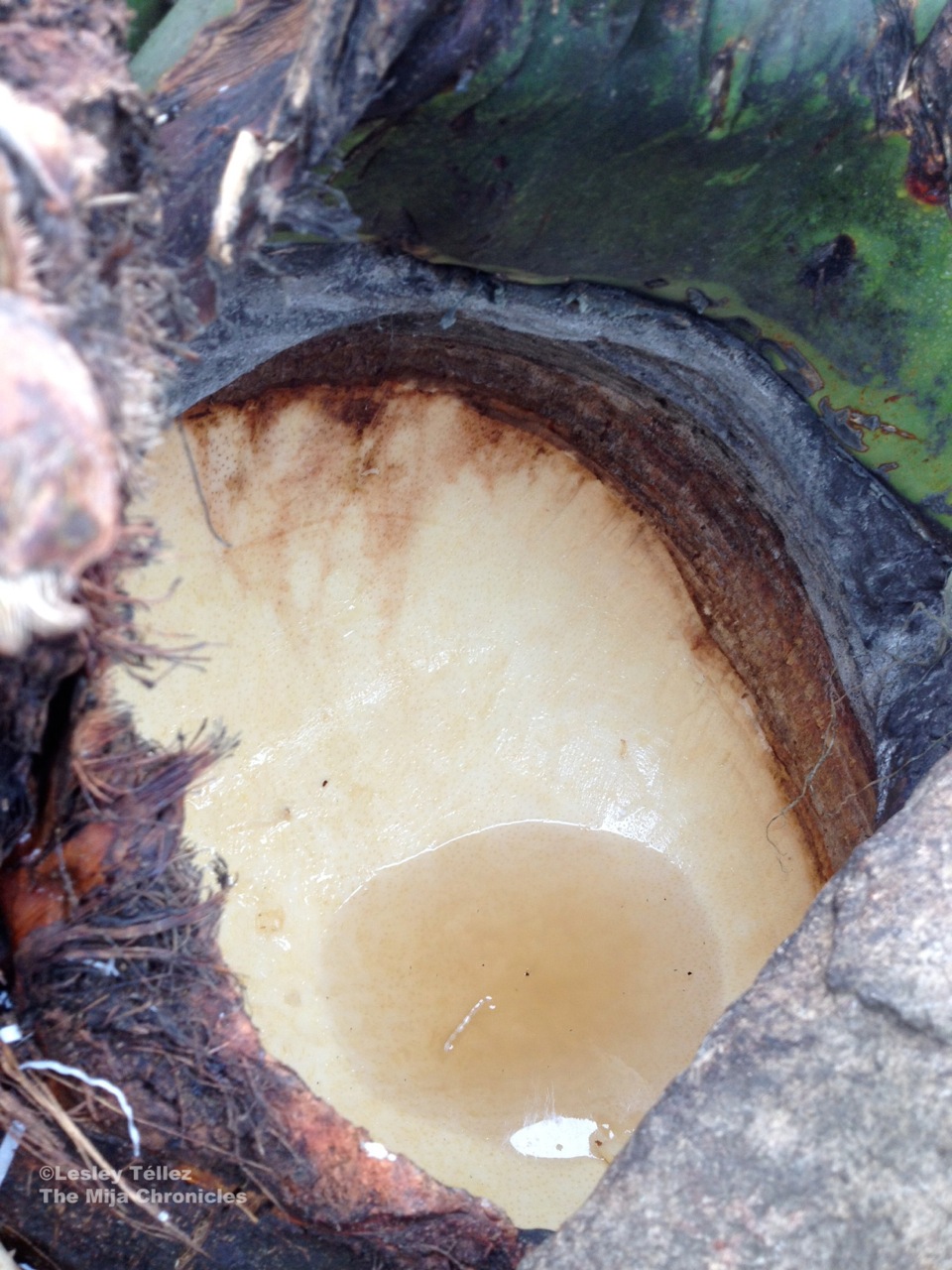
Natural sap, or aguamiel, from the core of the maguey plant.

Natural sap, or aguamiel, from the core of the maguey plant.

A vat of fresh pulque in Nanacamilpa, Tlaxcala.

A vat of fresh pulque in Nanacamilpa, Tlaxcala.

The vat of "starter" pulque, which is used to jump-start the fermentation of the other tubs.

The vat of “starter” pulque, which is used to jump-start the fermentation of the other tubs.

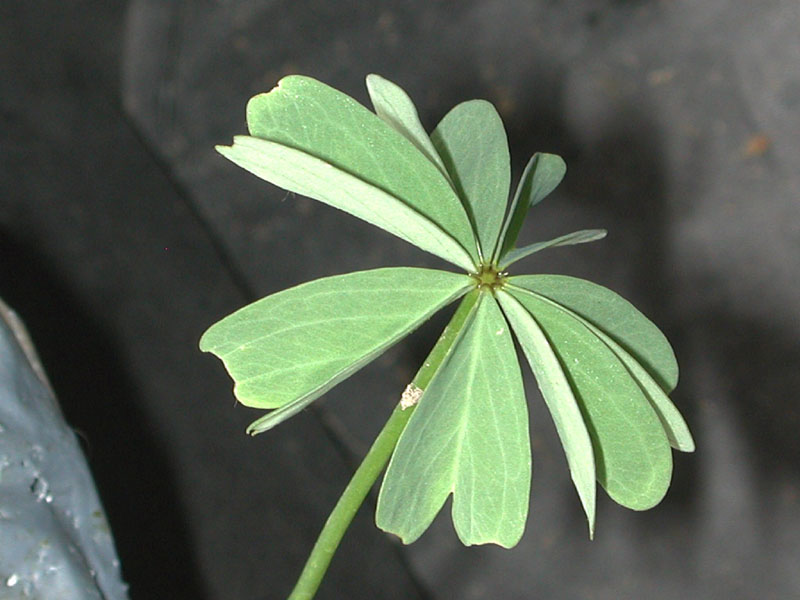
We wandered among the apple trees, the fruit dappled with dew in the chilly morning air. We met a few of the pigs. (From afar.) Don Miguel offered us a taste of lenguas, a type of quelite that grows like a weed on the farm. They reminded me a little of chivitos.

Quelites de lengua, which are delicious raw.

Quelites de lengua, which are delicious raw.

I took way too many pictures of these apples -- couldn't help myself.

I took way too many pictures of these apples — couldn’t help myself.

Paco loving on the land.

Paco loving on the land.

At the end of a few hours, he gave us some more small souvenirs: a gorgeous wild mushroom, known locally as “yema de huevo,” and a fresh mixiote, or the papery skin of the maguey leaf. The latter is used to steam meat or vegetables in Mexican cooking, and is usually wrapped around some sort of guisado.

To peel the mixiote, Don Miguel first climbed inside a maguey plant — literally; they’re that big — and then searched for the proper penca. He saw one and then gently tugged on its papery outer layer.

Don Miguel peels back the outer skin of the maguey leaf, known as the mixiote.

Don Miguel peels back the outer skin of the maguey leaf, known as the mixiote.

Peeling off the mixiote, or outer skin of the maguey leaf.

Another view of the mixiote, as it’s freed from the leaf.

This papery skin is almost pulled off entirely now.

Almost done…

Handing over the fresh mixiote leaf to Lulu, who's going to take it home and make fresh mixiotes, or steamed packets filled with veggies or meat.

Handing over the fresh mixiote leaf to Lulu, Paco’s wife.

Awestruck at the size of the mixiote!

Awestruck at the size of the mixiote!

Lulu, Paco's wife, poses with Don Miguel.

Lulu and Don Miguel.

A wild "yema de huevo" mushroom in Tlaxcala, Mexico.

A wild “yema de huevo” mushroom in Tlaxcala, Mexico.

Another view of the yema de huevo mushroom.

Another view of the yema de huevo mushroom.

Of course, we couldn’t leave without trying the pulque. I’d hoped it would be the best pulque I’d ever tried, but it wasn’t. It wasn’t bad, either — just the same thick, viscous, sort of tart drink I’d had before. This one, however, didn’t smell bad. It smelled like plants and yeast. I drank about half a water bottle’s worth (there were no cups there), and Don Miguel promptly filled up my bottle again for a second helping. I’m not sure if it was the cold air or the fact that I hadn’t slept, but finishing up the pulque, I was, as they say in Mexico City, “happy.”

We ended our visit to Nanacamilpa with lunch at a local fonda, which had been arranged by Mojdeh’s friend Gloria. There was only one table, so we crammed together in a spot not too far from the comal (which is actually the best seat in the house). Two women made us plates overflowing with tlacoyos, filled with alberjón as is typical in that area of Mexico, and various guisado-filled quesadillas.

Quesadillas filled with various guisados -- tinga, mushrooms and picadillo -- at a small fonda in Nanacamilpa.

Quesadillas filled with various guisados — tinga, mushrooms and picadillo — at a small fonda in Nanacamilpa.

Tlacoyos filled with alberjón in Nanacamilpa, Tlaxcala.

Tlacoyos filled with alberjón in Nanacamilpa, Tlaxcala.

I’m already thinking about going back. We spent half the day there and we didn’t see the market, or visit the larger pulque manufacturer who exports to the U.S. Next time! And next time I’m going to Hidalgo, too — there’s another pulque world that I haven’t explored.

Filed Under: Pulque & Mezcal, Travel Tagged With: pulque, quelites, tlacoyos, Tlaxcala

Rustic quesadillas de xocoyol, in the Estado de México

July 3, 2013 by Lesley Tellez

A xocoyol quesadilla, made from a plant in the Estado de Mexico

A xocoyol quesadilla, made from a plant in the Estado de Mexico

This past weekend, I visited some new friends at their home in Xalatlaco, a small city in the State of Mexico. For breakfast — a late breakfast for me, around 11 a.m. — they made quesadillas de xocoyol. The plant, which grows in nearby corn fields in June and July only, has a sharp, citrusy, sour taste, as if the leaves had been dipped in lime juice.

My friends, three women, mixed the greens with curls of white onion and a few thin veins of chile de árbol. They made blue corn tortillas from fresh nixtamal.

They laid the tortillas on the comal in thin sheets, then, once the tortillas had cooked, topped them with big handfuls of the xocoyol mixture, sprinkled with salt. There was no cheese. Everything steamed under the hood of the blue corn tortilla, and eventually, after several minutes, we had a soft, soft mixture without a single drop of oil.

“Te enchilaste?” one woman, Sra. Rosa, said after I took a bite. I shook my head. The quesadillas were lovely. Sort of like nopal in terms of the acidity, with a little punch of heat.

Apparently you can find xocoyol in Tlaxcala and the State of Puebla, too, although I’m not sure it’s the same plant. Does anyone out there know it?

Filed Under: Traditional Mexican Food Tagged With: antojitos, Estado de México, nixtamal, quelites, quesadillas

Adventures in quelites: chivitos

November 30, 2012 by Lesley Tellez

I spotted these at the edge of the Condesa tianguis a few weeks ago, at the stand in front of the Oxxo. The stand is staffed by a man and a woman from Ixtlahuaca, in the State of Mexico, and I like to buy there because they always have farm-fresh produce and homemade tortillas and wild mushrooms when it’s mushroom season.

I hadn’t seen these specific quelites before, so I asked the woman what they were. She said chivitos. I liked their long stems and thin, tender leaves, so I bought a bag for around 15 pesos. Thought about combining them with quelite cenizo in a salad and figured the contrast in shapes would be nice. It was — the cenizo-chivito salad was the best I think I’ve ever made in my life. It was grassy and green, and I was overwhelmed with the sense that I was eating something directly from the ground.

According to my helpful quelites research guide (“Los quelites, tradición milenaria in México” by Delia Castro Lara, Fracisco Basurto Peña, Luz María Mera Ovando and Robert Arthur Bye Boettler), it turns out chivitos (calandrinia micrantha) are one of the handful of “collected” greens in Mexico, which means they’re not cultivated. They tend to grow in corn fields or in the milpa, and they are are also called lengua de pájaro, or bird’s tongue.

The taste is interesting. Chivitos have the crunchy juiciness of lettuce, with a slight bitter aftertaste, like spinach. And they’re herbal and grassy.

Besides the quelites salad, I also used chivitos plain on their own, topped with a little lime juice and olive oil, as a side salad to roasted chicken and potatoes. This morning mixed them with scrambled eggs, topped with some roasted tomato salsa. Yum.

If you want to seek them out, the man-and-woman team usually arrive to the Tuesday Condesa tianguis around 11 a.m. If they’re out of quelites, you could also try another farm-fresh stand on the opposite end of the tianguis, sort of catty-corner to the chicharrón.

Chivitos at the Condesa tianguis

Filed Under: Streets & Markets Tagged With: quelites, Vegetarian

Adventures in quelites: Flor de nabo

February 16, 2012 by Lesley Tellez

The first time I saw flor de nabo was a few years ago on a sidewalk in the Roma. A woman was selling it out of a big plastic bag, and I, ever the quelite-scouter, stopped to ask her: “Qué tipo de quelite es?” She said flor de nabo. I loved how pretty it was, so I bought a kilo right there.

It turns out flor de nabo is brassica rapa, a type of spicy, peppery green that’s in the same family as rapini or broccoli rabe. They look similar.

Flor de nabo

Flor de nabo drifted out of my life until last week, when I saw it on the menu at Rosetta, an Italian restaurant in the Roma. Then a few days later I found a sidewalk vendor selling a bagful near the Meracdo Portales.

Cooking flor de nabo

When raw, flor de nabo tastes bitter and sharp. Cooking it for a long period of time in broth brings out its natural sweetness, with little touches of mustard and pepper. Because it was so rainy and dreary outside, I bought a kilo from the Portales vendor and decided to make soup. (Another day I’ll maybe try to attempt Rosetta’s garlickly flor de nabo with orecchiette pasta.)

The soup ended up being just what I craved: comforting and hearty, with just enough pizzazz to brighten up the gray day. Here’s the recipe, in case you’re needing some comfort-food inspiration.

Chicken Soup with Flor de Nabo, Carrots and Noodles

Ingredients

For the broth:
1 chicken breast
1 small piece onion (about 1/4 chunk of small onion)
1 bay leaf
5 or 6 peppercorns
1/2 teaspoon dried thyme
1 big clove garlic
Salt

For the soup:
1/2 medium onion, chopped
2 cloves garlic, minced
3 carrots, chopped
About 1/2 pound flor de nabo, chopped (stems included)
100 grams noodles of your choice
Salt to taste

Directions

Place the chicken breast in a pot and cover with water. Add onion, bay leaf, peppercorns, thyme and garlic, with a few pinches of salt. Bring to boil, skim off any scum and then lower the flame. Cover and simmer for 40 minutes, or until chicken is cooked. Note that the time is variable — my chicken breast weighed about a pound, but for smaller chicken breasts and regular altitudes, I’d start checking at the 25-minute mark.

When chicken is cooked, remove from the flame and cool while you chop your vegetables. Then strain the broth and reserve both the broth and the meat separately.

Heat about a tablespoon of oil in a heavy-bottomed pot. Add the onion and cook until translucent; then add garlic and stir, cooking with the onion until aromatic, about 30 seconds. Add the carrots and mix well. Then add the chopped flor de nabo, some pieces of chicken breast (I just tore some off with my hands and shredded it directly into the pot) and your reserved chicken broth. (You can add as much broth as you want, depending on how thick you like your soup.) Season with more salt and black pepper.

Bring the soup to a boil, then lower the flame, cover and simmer for 20 minutes. Add noodles and cook until al dente. Season for more salt and pepper and serve hot.

Filed Under: Streets & Markets Tagged With: quelites, soup

Adventures in Mexican produce: Quelite cenizo

October 10, 2011 by Lesley Tellez

I’ve mentioned it several times, but I’m a big fan of quelites. The word is an umbrella term for any wild, native Mexican green, usually one that has small leaves (smaller than spinach or chard).

Mexico City supermarkets don’t sell them. I usually find them on the outer edges of the tianguis, where the vendors often come directly from farms. They set up directly on the sidewalk and sell gorgeous, non-uniform produce: round, plump squash with raised ridges; prettier than usual squash blossoms, tortillas, tlacoyos, and bags of these quelites.

In the past I’ve bought quintoniles, which have a purplish tinge. But last week I saw another type of quelite I’d never bought before — quelite cenizo. The name translates to “ash quelite,” because some of the leaves look like they’ve been dipped in ash. My batch was pretty much all green.

I’ve never paid more than 15 pesos (just over a dollar) for a kilo of quelites. They don’t cook down as much as spinach does, and they’re highly nutritious, so there’s really no excuse not to buy them.

What do you do with quelite cenizo?

As is the case with most quelites, you can stew them. In Mexico, this is known as “guisar.” The traditional preparation calls for washing the quelites very well beforehand — they tend to collect a lot of dirt — and them simmering them gently in a pot of water until tender.

From there, you can chop them up (or not, if you’re lazy like me) and sautee them in chopped onion and garlic. You could add a chile sauce, like tomatillo with serrano. But I like them plain. After cooking, you serve them with beans and tortillas.

Last night I used my quelite cenizo as an enchilada filling. Post on that to come. I’ve also mixed them with vegetables and served them over quinoa.

What does quelite cenizo taste like?

They’re mild and slightly sweet, similar to quintoniles and other quelites I’ve tried. The great thing about them is they don’t turn slimy once you’ve simmered them in water. All quelites I’ve tried, including one called nabo, hold their texture.

If you eat quelites, let me know below — what’s your favorite way to prepare them?

Filed Under: Streets & Markets Tagged With: quelites, tianguis

The food of San Pedro Atocpan and Milpa Alta, in southern Mexico City

October 5, 2011 by Lesley Tellez

I’m friendly with the guy who sells me chiles and mole paste at Mercado Medellín. Over the years we’ve talked about me visting him in San Pedro Atocpan, the village where he lives, about 90 minutes southeast of the city center.

San Pedro is part of the delegación de Milpa Alta, which, along with Tlalapan, makes up the southernmost area of the Distrito Federal. (Think about that. You can ride a bus for 90 minutes in this city and you’re still within the city limits.)

A few weeks ago I finally had a weekend free, and so Crayton and I and our friend Chris rode the pesero out to San Pedro early one Sunday morning. The bus took us through Xochimilco, and then on a windy, two-lane road lined with cactus and corn. San Pedro is known for its mole, so I figured we’d check out a few markets and then have mole for lunch. I didn’t count on being completely hypnotized by the food.

The Milpa Alta Market

Once arriving in San Pedro, we took another pesero to Milpa Alta, a slightly larger city nestled in the hills. The produce there was even more gorgeous than in Xochimilco.

At a tianguis in front of the market, vendors sold local bluish-red corn, rabbits, herbs I’d never seen, quelites, and piles of wild mushrooms.

Check out the mushrooms for sale, on the sidewalk outside the market. Aren't they gorgeous?

Chile nuevo, sold outside the market in Milpa Alta. It's not very spicy.

This was just on the sidewalk. Erik, my friend, ushered us inside the market and vendors were selling wild mushroom tamales. I’ve never seen or heard of a wild mushroom tamale in three years of living in Mexico City. It was divine — picture meaty bits of mushroom, soaked in a green chile sauce.

A home-cooked meal in San Pedro Atocpan

I was happy just having gone to the tianguis in Milpa Alta. But Erik and his family had prepared a big spread for us at his house, with several local foods: mixiotes, esquites, fava bean salad, three types of mole. Everything tasted just as good as it looked.

Doña Belia, preparing tortillas at Erik's house in San Pedro Atocpan

Mixiotes

Those are the mixtiotes -- it's slow-cooked, spicy meat, cooked in maguey leaves like little purses. These were made with mutton.

Fava bean salad, one of my faves. It has onion, cilantro and queso fresco.

Blue corn esquites

Blue corn esquites! I'd never tried esquites with blue corn in Mexico. These were phenomenal.

Cecina and locally made chorizo.

Carrots, corn and squash

A basket of goodies.

When in San Pedro Atocpan… try the chicharrón

There was a bowl of chicharrón on the table at Erik’s house, and I’m telling you, it was the best chicharrón I’ve had, ever. It was this deep-brown caramel color, and thick and crunchy, not like the wimpy beige stuff I usually see in the markets where I live.

I asked Erik why it was so good and he said: “It’s homemade.”

I thought all chicharrón in Mexico was homemade? If anyone out there knows the difference between the two chicharrónes — the beige, more mainstream variety and the rustic dark-brown stuff — I’d love to hear about it.

Homemade chicharrón

The best chicharrón I've ever had in my life, hands-down.

I’m planning another visit out there hopefully in the next few months. If you’re interested in visiting yourself, San Pedro Atocpan is hosting a mole festival through the end of October.

Filed Under: Streets & Markets, Travel Tagged With: milpa, pesero, quelites, san pedro atocpan

Rainy season food: A simple guisado de quelite

June 29, 2011 by Lesley Tellez

I think Tlaloc must have been paying attention to my dude-check-out-the-mountains post, because for the past five days, it’s rained every day. Nothing too scary. Just a nice, steady drizzle starting around 4 or 5.

So my sandals have gone back into the closet. I’ve replaced my light cardigans for a cheery, cobalt-blue cropped raincoat. I know Americans tend to think of rain as dreary, but it doesn’t feel that way here at all. At the markets we’ve still got mangoes, small stone fruits, luscious mameys (oh god — you should see their sunset-red flesh) and, the best of all, an abundance of quelites, which I’ve talked about on this blog before.

“Quelite,” pronounced keh-LEE-tay, is a catch-all term for pretty much any tender Mexican green. Epazote is considered a quelite, as is purslane (verdolagas), watercress (berros), chaya, romeritos, pápalo, pipicha. I ended up buying a big bunch of tender, almost peppery-tasting quelites from one of my favorite vendors for 10 pesos. They sat in my fridge for almost a week, washed and disinfected and stored in my salad spinner.

Last night I didn’t feel like cooking or eating out — there is such a thing as running to my corner empanada joint too many times — so I took out the quelites and made a quick guisado, tossing the leaves into a mix of tomato, onion and garlic.

On my tours, I talk a lot about how guisados are one of the workhorses of Central Mexican cuisine. A guisado doesn’t have to be anything fancy. It can have chile, or not. It can have garlic, or not. Generally it has a base of chiles, garlic and onions, and an acidic element like tomato or tomate verde. But the tomatoes don’t necessarily have to be cooked and blended. I chopped mine.

The result was comforting and simple, and I felt good for being healthy for once. You should know that last week I ate antojitos like a fiend. Gonna post a recipe for gorditas soon.

Simple Guisado de Quelite (greens stewed with tomatoes, onion and garlic)
Serves 4 with rice or grain of your choice

With a guisado, there aren’t really any rules, but Mexican cooks tend to not go overboard on the onion. You just want the perfume of onion flavor — you don’t want onion por todas partes. And of course it helps to use the freshest vegetables you can find.

2 pounds quelites, or any other green of your choice, washed and thick stems removed
1/2 to 3/4 small onion, chopped
1 clove garlic, peeled and minced
1/2 to 1 jalapeño or serrano chile, seeded and minced (optional)
3 to 4 ripe tomatoes, chopped
Chicken or vegetable broth, or water

Heat a small amount of oil in a skillet over medium-high heat. Add the onion and cook until translucent. (In Spanish, this is called “acitronar.”) Then add the garlic and chiles and cook until aromatic, usually just a few seconds. Add the tomatoes and cook, lowering the flame a little so they don’t dry out too quickly. When tomatoes have softened, add the greens and about 1/2 cup of liquid. Bring to a boil and add salt to taste. The amount of liquid is really to taste here, too — you can make it as soupy or as thick as you like.

Simmer the mixture gently, covered, until the greens are tender and the flavors have mixed together. Serve with warm tortillas, rice, quinoa, or grain of your choice.

Filed Under: Recipes Tagged With: quelites, Vegetarian

Homemade veggie enchiladas with quintoniles, corn, rajas and onion

June 22, 2010 by Lesley Tellez

Just so you know what caliber of dish we’re dealing with here, I served these to Alice as leftovers last week. She took a few bites and said: “Lesley. I think this is the best thing you’ve ever made in Mexico.”

I’m sure it was the quintoniles. And the homemade tomato-based enchilada sauce.

I didn’t explain this very well in the other post, but quintoniles really like a lighter version of spinach. You don’t get any of the bitterness. None of the squeaky texture across your teeth. Just mild, mellow flavor. They’re like the Dazed and Confused green, just wanting everyone to relax and enjoy themselves.

This veggie combination came about somewhat randomly. Somehow, all the stars aligned and everything I hoped to happen, did: The enchiladas were hearty and light at the same time; sweet and salty; toothsome from the corn, and lightly fried tortillas.

Not to get all weird-bohemian-girl on you, but I felt a sense of time passing as I ate them. Like, suddenly it became very clear that the pre- and post-Mexico me had morphed into two different people.

This is because I have a little bit of a history with enchiladas. In my 20s, when I lived in Texas, enchiladas were one of my “go-to” dishes. I’d dip the tortillas in canned sauce, blanket them with cheese and bake them. Sometimes I’d wear an embroidered Mexican blouse as I cooked, just to let people know, you know, that I was Mexican-American.

People would ooh and ahh when the dish came out of the oven. I’d think: I am so proud of myself for serving real Mexican food from scratch.

And here I am today. The two things I’d always wanted — to live in Mexico, and speak Spanish — have happened. I know more about Mexican food than I ever thought I would, and most of what I truly enjoy is nothing like the cheese concoction I used to make. (My favorite Mexican dishes don’t have any cheese at all.)

I still wear my Mexican blouse, but just because I like how it looks, not because I want to express any overt cultural connection.

Really, I’m just more confident in myself. And my cooking.

Funny how one bite of food can stir up all that, no?

Here’s the recipe.
…

Read More

Filed Under: Recipes Tagged With: Chicano identity, quelites, tortillas, Vegetarian

Sorry spinach, you’ve been booted for wild quintoniles

June 16, 2010 by Lesley Tellez

Last Sunday I stopped by my old neighborhood tianguis, where I found man and a woman with a particularly fresh batch of produce for sale.

Everyone else’s curly-leaf lettuce looked wilted that day, but theirs was bright green and perky. They had fresh huitlacoche and spinach. And, in one big basket, a mess of dark-green, heart-shaped leaves. Some had purple splotches. I’m a sucker for greens, so I went over and stared. Crayton stood nearby, probably thinking, “Can we go now?”

“Epazote?” I asked the vendor.

“Quintoniles,” he told me. He pronounced them keen-toh-NEE-less.

My heart leapt a little bit. Mind you, I didn’t entirely know what they were, but they sounded like quelites, a wild Mexican green with a spinachy flavor.
…

Read More

Filed Under: Streets & Markets Tagged With: quelites, Vegetarian

Primary Sidebar

Who is Mija?


Mija is Lesley Téllez, a writer, mom, and culinary entrepreneur in New York City. I lived in Mexico City for four years, which cemented my deep love for Mexican food and culture. I'm currently the owner/operator of the top-rated tourism company Eat Mexico. I also wrote the cookbook Eat Mexico: Recipes from Mexico City's Streets, Markets & Fondas.

Search this site

Buy My Book On Amazon

Eat Mexico by Lesley Tellez

Get The Mija Chronicles in your inbox

Enter your email address:

Delivered by FeedBurner

Read my old posts

Copyright © 2026 · Foodie Pro & The Genesis Framework