• Skip to main content
  • Skip to primary sidebar

The Mija Chronicles

Mexican food and culture, on both sides of the border

Traditional Mexican Food

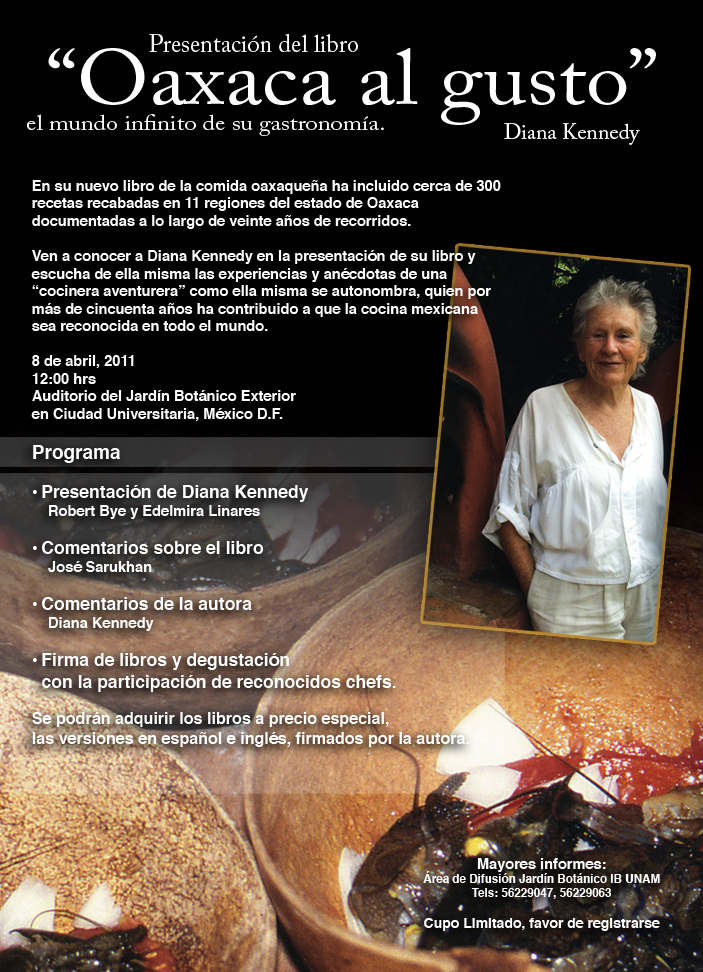
An afternoon with Diana Kennedy at Mexico City’s UNAM

April 13, 2011 by Lesley Tellez

It seems like everything I’ve dreamed of doing in Mexico, Diana Kennedy has already done — which makes sense, considering she arrived here in 1957.

Kennedy has worked in a Mexican panadería. She has toured the country befriending fabulous cocineras, and coaxed out the secrets of their prized recipes. She’s passionate about preserving traditional Mexican cuisine just as it is. And she hasn’t wavered in that mission, even into her 80’s.

Last Friday she gave a book presentation at UNAM’s Jardín Botánico, hosted by the university’s Instituto de Biología. The event honored her new cookbook, Oaxaca al Gusto, and Kennedy was scheduled to give some remarks and sign copies. Afterward the crowd could partake in a Mexican food degustación.

The event was open to the public, but the simple flyer belied how star-studded the afternoon actually was. Preparing the tasting were some of the best-known women in Mexico City cooking: Carmen “Titita” Ramirez of El Bajío; Gabriela Cámara of Contramar, and Marcela Briz of El Cardenal. Kennedy herself had brought beans she’d prepared at home in Zitácuaro.
…

Read More

Filed Under: Traditional Mexican Food Tagged With: Food, Mexican cooking

Where to eat in Mexico City: Con Sabor a Tixtla

April 5, 2011 by Lesley Tellez

Con Sabor a Tixtla, a fonda in the Col. Roma. Photo by Martin de la Torre.

I stumbled on Con Sabor a Tixtla by chance.

I’d been wandering around the Roma neighborhood, looking for a few new places to add to Eat Mexico’s Taco Tour, when I saw a chalkboard menu propped up on the sidewalk. Colorful tables and umbrellas had been spread out in a neat row, and baskets of paper flowers dangled underneath the awning.

The cheeriness of it all made me stop. And so did the menu. This place offered “tacos guerrerenses.” What were those?

As soon as I sat down, the waiter dropped off a little bowl of toasted pumpkin seeds. They didn’t taste like any pumpkin seeds I’d had before. Sheathed in their papery armor, they were crunchy and warm and tasted like the sun.

Then came a little bowl of beans, another botanita provided by the house. And then, on the waiter’s recommendation, I ordered a mole verde taco.

Like the pumpkin seeds, this mole was unique — herbal, assertive, not subtle as green moles normally are. (Marilau would call these pipianes.) The waiter explained that the mole contained a mix of hoja santa, avocado leaf, pumpkin seeds and something called hoja de mole. Most of the ingredients were brought directly from Tixtla, a small town in Guerrero state.

Then this man, whom I’d later find out was Alfredo, one of the owners, volunteered another nugget: his mother cooked all of the food.

At that moment, I felt really, really lucky to be living in Mexico.

I ended up adding Con Sabor a Tixtla to my Taco Tour, and I’ve since gone back several times. It’s right around the corner from my cooking school and Mercado Medellín, so when I’m in the neighborhood, I like to stop and say hi to Alfredo, who runs the place with his brother Juan Patricio. Once I even saw Yuri and Edmundo there — they’re big fans of the place, too.

The food, prepared by Alfredo and Juan Patricio’s mother Enedina Bello, consistently tastes like it’s been cooked with love and care. The menu focuses on typical items from Tixtla, so they’re items you rarely see anywhere else. Besides the herbal mole, there’s fiambre, a mix of marinated meats and crunchy bits of chorizo served with white bread; Tixtla-style tostadas with sweet-and-sour dressing, and pollo enchipotlado, or chicken stewed with tomatoes, raisins and chipotle peppers.

And the salsas — the salsas! The ensaladita de rábano, made from hoja santa stems, lime, onion and radish, waps you over the head with its simplicity. A smoky, creamy salsa de jalapeño con aceite tastes like it contains avocado, but it’s actually just jalapeños fried with onion and garlic, and blended with olive oil. I wanted to gulp it down like milk in a cereal bowl.

Con Sabor a Tixtla recently added a list of platos fuertes to the menu, and they do a special pozole guerrerense once a week. But if you go, you must get the fiambre. The meat is falling-apart tender, and seasoned simply but dazzlingly — the kind of seasoning I wish I could emulate as a home cook. It’s served on a bed of lettuce that’s dressed the same salsa agridulce that comes with the tostadas. The dressing tastes like something you’d get at an Asian restaurant, which makes sense, considering Acapulco (Guerrero state’s biggest city) was Mexico’s major port to Asia and the Philippines for 250 years.

On my last visit to Con Sabor a Tixtla, my friend Martin and I found ourselves sopping up the fiambre sauce with hunks of bread, even though we were stuffed. Here’s the plate before we tore into it.

Here are a few more photos of the place. If you’re in the mood for a visit, it’s located at Manzanillo 45b, in between Coahuila and Campeche. They don’t have a website, but they do have a Facebook page.

UPDATE: Con Sabor a Tixtla has moved! You can find them now at Chiapas 173, near the corner of Medellín. They’re right next door to the pastes shop. The fonda also now has a website.

…

Read More

Filed Under: Restaurant reviews, Traditional Mexican Food Tagged With: Food, tacos, Travel

Tips on making tamales, for beginners and/or perfectionists

February 16, 2011 by Lesley Tellez

Fresh corn husks, waiting to be filled with masa

I’m going to be honest with you: the idea of making tamales from scratch used to scare the heck out of me.

Even after I hosted my first tamalada in December 2009, I still felt like I had no idea what I was doing. What if I added too much masa? Too little? What if my tamales broke open and fell apart in the steamer? What if my masa turned out too dry? God forbid, what if I spent an entire afternoon making them and they weren’t any good?

A few weeks ago, I had a tamale breakthrough. It was during the Día de la Candelaria cooking course. Everyone was working quietly, divided into teams of two and three. I was scooping corn into probably my 20th tamal de elote when I realized… it didn’t really matter how much masa goes into the husk. Well, okay, it did — I couldn’t put so much that the masa oozed out. Outside of that, though, the tamal was going to steam no matter what. It would turn out fine.

This was a true epiphany for me: The tamal would behave responsibly. I just had to release control, and let it.

In that vein, here are a few tips on making homemade tamales, in case you’re still battling with the tamal like I was.

…

Read More

Filed Under: Traditional Mexican Food Tagged With: Food, Mexican cooking

Cooking a homemade Oaxacan meal, metate and all, with Reyna Mendoza

January 26, 2011 by Lesley Tellez

The ingredients to make a stellar mole

We arrived at Reyna’s house with two baskets full of produce. She unlocked the heavy gated entrance and we stepped through the doorway. In front of us was an open, tranquil courtyard with a dirt floor. This is where we’d cook and eat.

The kitchen lay just beyond the herb garden. Cooking utensils hung on the walls, and a bright red piece of oilcloth (called “charomesa” in Spanish) was draped on a blue work table. She had spatulas, metates, molinillos, clay ollas and a gargantuan tortilla press. At the edge of the kitchen sat a wood-fired stove, crowned with two clay comales.

This tortilla press weighs a ton -- it's the secret to a thin tlayuda.

On the other side of the kitchen, hundreds of corn cobs dried and crinkled under the sun. Across from them, rows of fat squash sunbathed, too, some with hunter-green mottled skins. Reyna’s dad grows the squash and the corn on a farm not too far from her house.

Corn cobs drying in the sun. They'll use the corn for tamales and tortillas, among other things.

I felt like Julia Child visiting the south of France for the first time. The splendor of the land! The fecundity! I lingered around the squash and asked Reyna: “Are any of these for sale?” She said after class I could pick out a few I liked.

We unloaded our provisions in the kitchen and she set about preparing chocolate to go with our sweet bread. I tried to pay attention, but I was overwhelmed by my new environment. I felt very lucky to be there. Even the plate of pan dulce looked like it came from a dream.

The crunchy, pretzel-shaped piece ended up being my favorite.


…

Read More

Filed Under: Traditional Mexican Food, Travel Tagged With: cooking classes, Oaxaca, Reyna Mendoza

How to make ponche, the traditional Mexican Christmas punch

December 13, 2010 by Lesley Tellez

Ponche is a warm tropical-fruit punch. As I mentioned in my previous post — thank you for all the wonderful comments! — it’s traditionally imbibed in Mexico during Christmastime. Vendors sell it at night near the sidewalk Christmas markets. It’s also served with buñuelos during the posadas.

No one seems to know exactly how and why Mexican ponche materialized. In general, historians seem to agree that the punch concept originated in India, where English sailors took a liking to it and brought to Europe. The Spaniards (or the French?) must have carried the tradition to Mexico.

Today, the base of Mexican ponche comprises piloncillo, a dark-brown unrefined cane sugar, mixed with water and cinnamon sticks. To that, you can add pretty much any winter fruits you want: apples, oranges, guavas, tejocotes.

The latter two are key. Tejocotes are small, speckled orange fruits with an apple-pear taste, and their soft flesh turns almost creamy while soaking in the ponche.

Guavas lend just the right amount of tang and citrusy perfume. The smell of guavas cooking with cinnamon and sugar is intoxicating. Someday someone’s going to make a million dollars selling it to Williams-Sonoma as an air freshener.

The ponche workhorses: tejocotes (small orange fruits in front), guavas (left), apples and cinnamon

In addition to the fresh fruit, ponche can contain prunes, raisins, tamarind, walnuts. Some folks add hibiscus flowers, which gives the ponche a pretty burgundy color.

Ponche isn’t an exact science. Everything simmers together until the fruit is tender, and the dried fruits become plump, sugar-swollen nuggets. If you are like me, you will hover over the pan and give yourself a ponche facial, letting that sweet, spicy steam envelope your face.

You can’t see the steam in the picture below, but that’s because I was so smitten once the ponche started to cook that I forgot about my camera, and kept fishing raisins and tamarind pieces out of the pot to eat.

Ponche simmering on the stove

Ponche has a lot of ingredients, but it requires minimal chopping. If you have a helper the whole thing can be on the stove within 20 minutes.

If you like — and we do, in our house — a little nip of brandy, rum or tequila, feel free to add it in. Just make sure to serve the cups with a spoon, so everyone can dig into their boozy (or not) fruits.

Recipe below.
…

Read More

Filed Under: Recipes, Traditional Mexican Food Tagged With: Christmas, Cocktails, drinks

How to make homemade corn tortillas, using an electric grain mill

December 6, 2010 by Lesley Tellez

I wasn’t an immediate whiz on the Nixtamatic.

The instruction manual for my new corn grinder was woefully lean. It basically said, “Turn it on and enjoy!” so I waited until Lola came over to clean, thinking she might have intrinsic knowledge of how the thing worked because she was Mexican. (This seems like a ridiculous notion now, because very few Mexicans in this city grind their own corn. But I was flailing.)

Lola looked at the two-page manual, and I did too, over her shoulder. She looked over the parts and I did, too.

“I guess we should add some corn?” I said.

I had a bag of frozen nixtamalized corn, which I’d defrosted to use a test batch. We loaded it into the Nixtamatic’s collector tube and pressed the “on” button.

The plates squeaked and wobbled and corn went flying everywhere, ricocheting off the cabinets and onto the floor Lola had just cleaned. We both squealed and turned the thing off.

“Maybe that’s just what happens the first time you use it?” Lola suggested. I agreed, so we loaded more corn in the collector tube.

The same thing happened again.
…

Read More

Filed Under: Traditional Mexican Food Tagged With: Food, Mexican cooking

Introducing… my new electric corn grinder.

November 8, 2010 by Lesley Tellez

I saw the Nixtamatic in the window at Casa Boker a few months ago, but I convinced myself that I didn’t need it. I didn’t operate a tortillería. I didn’t have a large family. Was I really going to make fresh corn tortillas every day, just for Crayton and I?

Then I couldn’t stop thinking about it. I Googled “Nixtamatic,” and saw that Steve Sando had one, and he’d created a video of him using it. It was mesmerizing, watching the machine’s metal plates squeak round and round, churning out squiggly bits of masa. He only had to add a bit of water to the dough, and boom. It was done.

Why was I hesitating here? Sure, corn tortillas were available on every corner in Mexico City, but if I ever left Mexico — heaven forbid — I’d be stuck with the carboard-tasting American versions. And I just had this yearning to make my own tortillas. With my corn that I purchased. Who cares if I didn’t make them every day. Even once a week would be fine. I could do that.

When Crayton asked me what I wanted for my birthday this year, I told him, “A Nixtamatic!”

(Well, first I said, “No, honey, seriously, you don’t have to get me anything.”)

So we went last weekend and picked it out together. It wasn’t cheap — about 3,100 pesos, or around $250 USD. I refrained from telling Crayton, “Yes, but this is an investment,” because he hates it when I use the word investment for something we’re buying. (Him: “It’s not an investment because it loses value the minute we buy it.”) The high price meant this was my birthday, anniversary and maybe Christmas present rolled into one.

But I really do plan to use it a lot. Tortillas, tlacoyos, gorditas, sopes — the masa-based possibilities are endless.

Hopefully I’ll have an “Aaagh! Homemade tortillas with the Nixtamatic!” post for you next week. The manual is three pages long and seems easy enough to understand. I’m crossing my fingers.

Filed Under: Traditional Mexican Food Tagged With: nixtamal, Nixtamatic

Fun food finds at the Mexico City newsstand

September 29, 2010 by Lesley Tellez

Mexico City newsstands lie just about on every block, and they’re kind of funny places. Most of the magazines are wrapped in plastic, so you really can’t stand and read as much as stand and stare at the titles. The newspapers are often clothes-pinned to a rack so you can only see the front page.

Despite that, it’s super common for people here to just walk up to a newsstand and stare at what’s available. The vendor never rushes anybody, and he doesn’t say “Can I help you?” because it’s assumed that you’re going to stand there and peruse the titles awhile.

Usually I don’t like to while away my time at the newsstand. But today while walking home from yoga class, I felt so tranquila that I stopped at a newsstand and stared awhile. I bought an issue of Arqueología Mexicana devoted to sexuality in Mesoamerica. (“Have you read this?” I asked the vendor. “Of course!” he said. “What kind of vendor would I be if I didn’t read what I’m selling?”) And then I asked him if he could take a few recipe magazines out of their plastic.

They were the kind of cooking magazines I never buy — the off-size, glossy kind that look like they came with coupons in the mail. In fact, they’re part of an El Universal promotion called “Cocina Estado Por Estado,” aimed at highlighting different regional Mexican cuisines. A new recipe book devoted to a different Mexican state is released each Monday. There’s 11 so far, and there’ll be 21 in all, the vendor said.

I picked up the Oaxaca and Distrito Federal mags and both seemed really neat. The Oaxaca one came with recipes for tejate (corn and cacao drink), nicuatole de maiz (a drink, not the dessert), and horchata de melon, plus recipes for mole rojo and tamales oaxaqueños. The Distrito Federal version includes recipes for pambazos, chorizo verde, tacos al pastor, limones rellenos and pan de pulque.

I might try out a recipe on Saturday — the horchata de melon sounds especially good — and I’ll report back whether it actually works. Either way, these would at least be good references for my growing Mexican-food cookbook collection.

By the way — the Mesoamerican sexuality magazine is going to be my airplane reading. I’m leaving for a trip to the States next Sunday.

Filed Under: Traditional Mexican Food Tagged With: culture, Food, Mexican cooking

And… we have a winner!

August 23, 2010 by Lesley Tellez

Wow. I am so amazed by all the comments over the past three days. Y’all shared some fantastic memories, and I felt honored to read each of them.

I wish I could give everyone just a little something (and maybe I will get to do that someday, when I’m rich and famous), but alas, the package goes to one winner.

And he/she is….

Melodie! The commenter who ate turkey tamales wrapped in foil as a child, even though neither of her parents were Mexican.

Melodie, you’ll receive the sweets package from La Nicolasa. I’ll email you directly using the email address you provided in the comments.

Thanks again to everyone for playing.

Filed Under: Traditional Mexican Food Tagged With: Food, Mexican cooking

How to make a proper chile en nogada

August 16, 2010 by Lesley Tellez

Every year in late summer and early fall, the chile en nogada makes its brief run through Mexico.

The star ingredients, walnuts and pomegranate seeds, are not available any other time of the year. So it’s a festive time. Restaurant storefronts become festooned with “We have chiles en nogada!” banners. Pomegranates glitter at the tianguis. Mexican Independence Day is right around the corner (on Sept. 16), and the dish is pretty much the culinary centerpiece of the celebration.

To me, the most interesting thing about chiles en nogada is that it’s a living piece of Mexican history. Puebla nuns invented the dish in 1821, to honor a visit by Mexican General Augustín de Iturbide. The dish featured the colors of the Mexican flag: a poblano chile stuffed with dried fruits and nuts, covered in creamy walnut sauce (white) and sprinkled with pomegranate seeds and parsley (red and green). The Mexican flag was unveiled around the same period, so you can imagine the patriotic fervor.

Today, the chile en nogada sounds awfully baroque. Fruity meat? Pomegranate seeds? Who would eat that? At the time, however, nogada sauce was popular. And so was the idea of combining dozens of ingredients to create a complicated, tedious dish. (The Pueblan nuns also invented mole.)

Chiles en nogada is not an easy dish, and it’s not meant to be. That’s part of the tradition. Walnuts must be peeled. Spices assembled. Raw and dried fruit, chopped. Even after assembling your chile, you must dunk it in egg batter and fry it.

In the olden days, the nuns didn’t have blenders, so they ground the walnut sauce on the metate. As someone who has done her fair share of metate-grinding, I can tell you that it had to take entire days of grinding to get the texture they wanted. Let me repeat that: days of grinding.
…

Read More

Filed Under: Traditional Mexican Food Tagged With: culture, Food, Mexican cooking, Photography

« Previous Page
Next Page »

Primary Sidebar

Who is Mija?


Mija is Lesley Téllez, a writer, mom, and culinary entrepreneur in New York City. I lived in Mexico City for four years, which cemented my deep love for Mexican food and culture. I'm currently the owner/operator of the top-rated tourism company Eat Mexico. I also wrote the cookbook Eat Mexico: Recipes from Mexico City's Streets, Markets & Fondas.

Search this site

Buy My Book On Amazon

Eat Mexico by Lesley Tellez

Get The Mija Chronicles in your inbox

Enter your email address:

Delivered by FeedBurner

Read my old posts

Copyright © 2026 · Foodie Pro & The Genesis Framework