• Skip to main content
  • Skip to primary sidebar

The Mija Chronicles

Mexican food and culture, on both sides of the border

Streets & Markets

Miércoles de carnitas

February 18, 2010 by Lesley Tellez

Lesley’s husband Crayton is guest-posting while she makes her way back from a trip to India.

So, after all those nice comments I got yesterday, I had to come back for an encore!

Just kidding. Lesley’s had some snags in her travel plans and is getting back to Mexico a little later than planned, so you’re stuck with me again today. But she’s doing just fine! Don’t worry.

This does give me the opportunity to tell you about my favorite Mexico City food: carnitas.

At the place where I work, eating these chopped pork tacos is a ritual so important that it has a name: Carnitas Wednesday, or Miércoles de Carnitas. Yesterday, just like every week, one of my co-workers took orders from the rest of the office and ambled out to the street to our favorite puesto. (Lesley has discussed the place before here (in her section on carnitas, where she notes it’s next to the pirated DVD stand on Rio Sena, just off Reforma in the Colonia Cuauhtémoc).)

We pay 10 pesos ($0.78) per taco, which includes the tip for the three people who work at the stand: the guy who chops up the meat with an enormous hatchet of a knife on a giant cutting board that looks like a slice of tree trunk; the lady who sits by his side, wraps up the to-go orders in foil and plastic baggies and handles the money; and the utility guy, whose main responsibility, I think, is to make sure the condiments (green and red salsas, limes, cilantro and onion) are all readily available. They run a pretty efficient operation.

My friend Carlos gave me lessons long ago on how to order carnitas: “de maciza, bien blanquita.” That means you want your meat really white and lean, without fatty chunks. A lot of Mexicans I know love the fatty chunks, but many Americans I know, including myself. find them icky. The risk you run with carnitas de maciza is that the pork is too dry, but our puesto does a pretty good job of keeping the meat moist. We’ve often found we get better meat if we show up before 2 p.m., when things get really busy.

The portions are generous, with tacos roughly the width of a can of cola on its side. Most of the time I can only eat two, though there are three-carnita days on occasion.

Our puesto just uses store-bought tortillas. If we feel like going all out, we buy some fresh-made tortillas and just order a bunch of meat from the carnitas stand.

Our puesto’s green salsa is fantastic, with an almost creamy consistency, not drippy. The mix of the spicy peppers with the sweet warmth of the meat… Wow. It’s gotten to the point where I wake up on Wednesday mornings already excited about lunch.
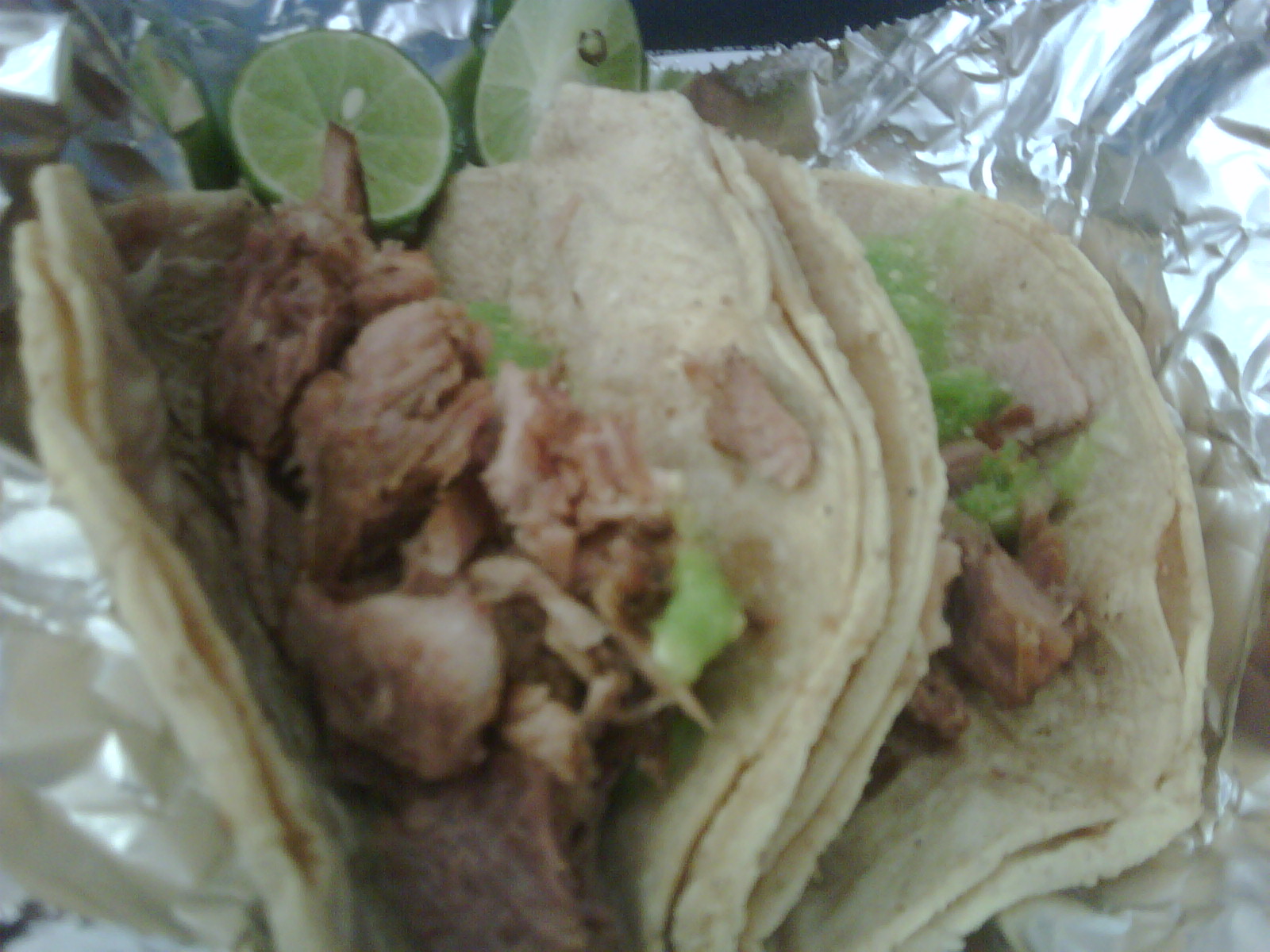
Yesterday's lunch

Filed Under: Streets & Markets Tagged With: carnitas, street food, tacos

Tacos de canasta, literally, “basket tacos”

January 7, 2010 by Lesley Tellez

It took me awhile to warm up to tacos de canasta. They’re the soft, steamed tacos sold on the street, and they’re usually stacked in cloth-covered basket.

Unlike at the regular street taco stands, where the vendors are furiously chopping meat or dunking flautas in a fryer, nothing really happens at a tacos de canasta stand. A man, or woman, stands under an umbrella next to a basket. The end.

I didn’t try them for months, because the idea of eating food that’s been sitting in a basket all day sounded kinda gross. But then one day Alice mentioned that they were her favorite. Her eyes rolled back in her head as she described this specific tacos de canasta stand near the Chapultepec Metro. (“Oh my god, they are so good.”) I tried them for the first time shortly afterward, at a stand in Tlalpan.

I’d chosen an potato and rajas taco, and the vendor lifted up a section of the cloth and handed me an oily taco that looked nearly translucent in the middle. I was momentarily disappointed (is this going to taste like a mouthful of grease?) but then I bit into it. The potatoes and rajas had been stewed into this soft mixture that you barely had to chew. It was the taco equivalent of baby food. I loved it, because it was comforting and simple, and sometimes you need a break from all that chopped meat on the street.

I’ve eaten tacos de canasta a few more times since then. Last week, I finally visited La Abuela, a crowded tacos de canasta stand in my neighborhood. The vendor is an old man who wears a newsboy cap, and he stands underneath a red umbrella. He has this weathered, kind face, like the stereotypical grandfather character in the movies. Every time I walk by, I steal a glance at him and think: he’s so cute.

He’s not smiling here, but I promise, when he does, it’s kind of adorable.

La Abuela has a pretty extensive variety for a street stand. Crayton and I chose the frijol, papa, tinga, chicken with mole, and cochinita pibil.

All of them had been cooked in the way that I remembered: oily tortilla, stuffed with a soft, stewed filling.

The cochinita and the potato were the best — the former with just a slight whisper of spices, and the potatoes, mashed to smithereens so that they slid down your throat with this kind of slick earthiness. They reminded me of the potatoes my great-grandmother used to make. She would slice them and fry them in lard, and then let them drain on paper towels for hours and hours, until they were so soft you could practically mash them with a fork.

I would highly recommend La Abuela if you’re in the neighborhood. The stand is located at the corner of Rio Rhin and Rio Lerma in Col. Cuauhtémoc, and it’s open from 6 a.m. to 3 p.m. daily. La Abuela also has other branches around the city, and they offer home delivery, if you’re having a party.

If you’re interested in making your own tacos de canasta, this site has pretty extensive instructions, including recipes for various fillings and how to properly line your basket to keep the warmth in.

Filed Under: Streets & Markets Tagged With: Cuauhtemoc, street food, tacos

A trip to Mercado de la Merced, and the search for a tamalera

December 17, 2009 by Lesley Tellez

I’d been dragging my feet on buying a tamale steamer pot, called a tamalera, for weeks. It’s a big, bulky steel thing, bigger (I imagined) than a stock pot. I wasn’t entirely sure where to buy it. Or whether I’d be able to carry it home.

Part of me also feared the whole buying process, because I had no idea what I was doing. How do you say “four-chambered steamer” in Spanish? What did a tamale steamer even look like up-close? What if some random vendor knew I was a foreigner, and decided to rip me off?
…

Read More

Filed Under: Streets & Markets Tagged With: Markets

Tacos in Guadalajara, 11 p.m. last night

December 1, 2009 by Lesley Tellez

They were as good as they looked. Interestingly, the process was a lot more orderly than I’m used to. We ordered from one person, who gave us a ticket, which we then handed to the taquero.

Most people also drove up in cars or SUVs. Some even ate inside their vehicles, which I personally think is blasphemy. Everyone knows that street tacos should be eaten while standing up, or sitting on a plastic stool.

Filed Under: Streets & Markets Tagged With: Guadalajara, street food, tacos

Mamey ice cream

November 23, 2009 by Lesley Tellez

After lunch on Saturday, Crayton and I went on a stroll through Plaza Rio de Janeiro in the Roma neighborhood. An ice cream vendor there caught my eye: she sat under a little tarp, with her metal ice cream cylinders wedged inside ice-packed buckets. Her flavors had been written in a whimsical font. One was fig with mezcal.

“Oooh, fig with mezcal!” I told Crayton.

“Do you want one?”

At this point we’d already walked by the place. “Well… no,” I said. “I shouldn’t.”

We’d just eat lunch. Which had included bacon.

“Are you sure?”

It’s truly astonishing how many times Crayton knows me better than I know me. I did want one, so we went back and I tasted the fig, which ended up being too sweet. But she also had mamey, a popular flavor in Mexico. Unbelievably, despite my mamey obsession, I hadn’t tried mamey ice cream yet. So I got one scoop.

I can’t even describe to you how good it was. It was kind of pumpkiny, and melon-y, and I think I detected some cinnamon. This morning I woke up thinking about it. And then I thought: I need to have an ice cream tasting party. I will gather all my ice-cream loving friends, make an ice-cream themed music mix, and then churn up three Mexican-inspired ice creams that I’ve been dreaming of lately: mamey, crema and piloncillo. We will have mamey splits, like a banana split, but better. We’ll cover our scoops with pumpkin seeds instead of walnuts. We’ll drink Kahlua-spiked coffee. (Which isn’t ice cream-ish, but fun nonetheless.)

This is going to happen. Stay tuned.

Filed Under: Mexico City, Streets & Markets Tagged With: ice cream, mamey

Traditional Day of the Dead candy

November 3, 2009 by Lesley Tellez

All the Day of the Dead festivities officially ended yesterday. Boo.

I did want to share with you, though: The Feria de Alfeñique had some of the neatest looking Day of the Dead candy, much of it from dulce de pepita, which is a thick, moldeable paste made from pumpkin seeds. It’s lightly sweet.

Almost everything was in miniature, which of course made the girlie side of me cry out. Especially when I saw the tiny pieces of sweet bread.

Tiny sweet bread-shaped candies, made from dulce de calabaza, at the sugar skull market in Toluca, Mexico

And then the teeny tortas. I bought one, just because they were so adorable. The man selling them joked, “Would you like one with ham or milanesa?”

Tiny candies shaped like Mexican tortas, sold at the sugar skull market in Toluca, also known as the Feria de Alfeñique

Quarter-sized tortas, made from dulce de pepita, at the Feria de Alfeñique in Toluca, Mexico

There were also candy rats….

Candy rats at the Feria de Alfeñique in Toluca, Mexico.

And hundreds of chocolates…

Chocolate at the Feria de Alfeñique in Toluca, Mexico

And tiny pieces of fruit, made from dulce de leche. (This is different from the dulce de leche in Argentina — it’s sweeter, and doesn’t have that warm caramel taste.) I liked dulce de pepita better, because it wasn’t as sweet.

Tiny pieces of fruit, molded from dulce de leche, sold at the Feria de Alfeñique in Toluca, Mexico

And that’s not even mentioning the sugary fruits and vegetables. They’re regular old pieces of fruit (or squashes, or sweet potatoes) that have been boiled down with sugar and slathered in honey. They’re eaten a piece at a time, so you can savor their extreme-sugar state.

My faves, for their pure unique value, were the shriveled carrots and the nopal.

Candied carrots, sold at the Feria de Alfeñique in Toluca, Mexico

Candied strips of nopal cactus, sold at the Feria de Alfeñique in Toluca, Mexico

Lastly, I saw chongos zamoranos, which I’d read about in a few cookbooks but never seen up-close. I pictured little knots of honeyed curds — not sure why. These looked kind of like fried pastry dough, and ended up tasting like thin, ultra-concentrated sheets of dulce de leche.

Basically, another big mouthful of pure sugar. The chongos were too sweet for me.

Chongos Zamoranos at the Feria de Alfeñique in Toluca, Mexico

Looking at all these now, I wish I would have bought more dulce de pepita. It’s 8:24 a.m., and I could really use a teeny torta right now with my coffee.

Filed Under: Day of the Dead, Streets & Markets Tagged With: candy, Dia de los Muertos, holidays

Day of the Dead sugar skulls in Toluca

October 30, 2009 by Lesley Tellez

Sugar skulls at the Feria de Alfeñique in Toluca, Estado de Mexico

I’m loving this time of year. Here I was, thinking the city went crazy for El Dieciséis, but Day of the Dead is so much more colorful, and soulful. Brightly colored sheets of papel picado hang in store windows. Velvety, crimson terciopelo flowers sit in vases at restaurants. Orange marigolds, the traditional Day of the Dead flower (called cempasúchil in Spanish) have suddenly bloomed in the street medians.

Some stores have even set up altars, which look like a series of steps draped in white cloth, and then covered in oranges, bananas, and bread. Yesterday I saw one at El Tizoncito, the tacos al pastor place.

I even got into the mood and created a small altar in our house. I draped a white crocheted doily on our buffet, and placed candles, cempasúchil in old jam jars, and photos of my grandparents, great-grandparents and my stepdad, who died when I was in high school. I’ve also got a tiny sugar skull wearing a wide-brimmed catrina hat, which I bought at the Feria de Alfeñique in Toluca. This is my first altar ever, by the way. I didn’t celebrate Dia de los Muertos growing up.

You absolutely have to go to the Toluca sugar skull fair, if you live anywhere close in Mexico or if you’re traveling during this time of year. They’ve got chocolate skulls. Sugar skulls. Skulls in cowboy hats. They’ve got all the traditional Mexican sweets, which I’ll write about in another post, because they’re just too detailed to try to cover here. I ate so much sugar — and a taco de quelites, to balance it all out — that I had a stomach ache on the car ride home.

Here are a few photos. If you’re interested in going, the fair is located just off the colonial square, about two blocks from the church.

Chocolate skulls with cotton "hair" at the Feria de Alfeñique in Toluca, Estado de Mexico

Skulls at the sugar skull market in Toluca, also known as the Feria de Alfeñique

Sugar skulls, ready to be personalized with a name, at the Feria de Alfeñique in Toluca

These skulls are ready to be personalized -- it's a custom to write a friend's name on the skulls' forehead.

Sugar skulls, made by a pair of brothers from Metepec, a city east of Toluca

Cowboy sugar skulls at the Feria de Alfeñique in Toluca, Estado de Mexico

Chocolate skulls at the Feria de Alfeñique in Toluca, Mexico

Oficios are traditional during Day of the Dead -- they're skeletons arranged in funny scenes that depict everyday life.

These are called oficios -- they're traditional during Day of the Dead, and the skeletons are always posed in funny scenes that depict everyday life.

Alfeñique piggies, or piggies made out of sugar, at the Feria de Alfeñique in Toluca, Mexico

A traditional style of alfeñique, or animal-shaped candy molded from sugar.

An ofrenda, or traditional Day of the Dead altar, located a few blocks from the Feria de Alfeñique in Toluca, Mexico

A traditional Day of the Dead ofrenda, or altar

Filed Under: Day of the Dead, Streets & Markets Tagged With: Day of the Dead

Three cool Mexico City markets

October 26, 2009 by Lesley Tellez

If you’ve got a few minutes, check out my guest post over on Ever The Nomad, a travel blog maintained by writer Anja Mutic. I wrote about three of my favorite Mexico City markets and why they’re so great. (Hint: pig uterus tacos, anyone?)

Be sure to leave a comment if you like what you read, or if you have your own favorite market experience.

Filed Under: Streets & Markets Tagged With: Markets

Acitrón, the crystallized cactus

October 2, 2009 by Lesley Tellez

Acitrón, a traditional Mexican dessert that's made of crystallized biznaga cactus

While at Central de Abastos last week, I spied squares of this jellied, lemon-yellow substance. “Acitrón,” a hand-painted sign read. They were 15 pesos each. (That’s little over $1.)

I remembered reading something about acitrón in the newspaper awhile back, but I couldn’t remember exactly what. So I bought some. Took it home, did a little googling, and found out that it’s crystallized biznaga cactus.

Not only that, but it’s semi-hard to find — the Mexican government declared the biznaga cactus in danger of extinction in 2003. Since then, according to El Universal, breadmakers all over Mexico have scrambled to find a substitute for acitrón in their Rosca de Reyes recipes, a traditional bread eaten during Three Kings Day. Most now use ate (pronounced AH-tay), another traditional type of jellied fruit.

I wasn’t up for making bread, or chiles en nogada, which is the other popular way to use acitrón. So a few days ago, I diced it and tossed it in a salad with toasted pecans. It had a mild, vegetal flavor I liked, despite being doused in sugar.

Apparently you can also eat it plain, as a dessert with your digestif. This woman chopped it up and stirred it into muffins, with figs and dried cranberries.

If you have any other acitrón suggestions, let me know. I’d love to hear them!

UPDATE: Check out the comments section for LaZorra’s very cool link to a photo of the weird-looking, roly-poly biznaga cactus.

Filed Under: Streets & Markets Tagged With: desserts

The Central de Abastos: La madre of all Mexico City markets

September 30, 2009 by Lesley Tellez

One of the views outside the Central de Abastos, a gigantic produce warehouse in Mexico City

Nearly every piece of wholesale produce in Mexico City starts out at the Central de Abastos. The gigantic maze of tunnels — can it even be called a market? — is huge. It has 2,000 stands. It shelters more than 30,000 tons of produce each a day. Located south of town, it’s the one meeting point for food that ends up at taco stands, fruterías and fondas all over the city.

It’s open to the public, and I’ve been dying to go there, just to witness the spectacle. So Alice and I went last week.

We got lost on the way there. Her guidebook said to get off at Metro La Viga. We did, and all we saw was a man on a bench reading a newspaper. We asked him where to go.

“Take the Metro to Aculco,” he said. “No, better yet, ask the poli in the metro station.” Poli (pronounced POH-lee) is slang for policeman.

Inside the metro station, we asked the woman inside the ticket window. She shook her head. “Ask the poli.”

Finally, we asked the policeman, who looked bored while he leaned against the turnstiles. Yes, he said, Aculco was correct. And then after that, we should take a pesero that said Central de Abastos.

About 1 1/2 hours after we started our journey, we hopped off the pesero and walked over a sky bridge to the Central.

Once inside, the first thing we saw were the bananas, hanging from one stand. They were so bountiful, they looked almost fake.

Bananas at La Central de Abastos in Mexico City

And then there was the garlic.

Hundreds of heads of garlic, at the Central de Abastos in Mexico City

Boxes of garlic at the Central de Abastos in Mexico City

Alice tried to buy some, but the woman said she only sold it by the half-kilo, minimum. That’s 12 bulbs of garlic, más o menos.

I wanted to wander down the aisles, open-mouthed. Maybe zen-out over the mound of watermelon.

Mountains of watermelon at the Central de Abastos in Mexico City

But we really couldn’t. The place was too busy. Men carted around produce on their backs, pulling dollies stacked high with produce boxes. Most had at least a half-dozen or more. They’d whistle — a sharp tweet-TWEET! — if you were in their way. I got whistled at a lot.

The onion aisle was pretty, empty though. Probably because of the overwhelming smell.

An aisle filled with onions at the Central de Abastos in Mexico City

We wandered around some more, marveling at the burlap sacks of dried chiles, the plastic buckets of loose cereal (guess this is for the morning street vendors), and the buckets of wholesale cajeta, yogurt, and fruit marmalades.

Central de Abastos also had a regular, neighborhood-style market, where you can buy produce by the half-kilo or less, or by the piece. It didn’t have much beyond what my local tianguis would carry, but it was fun to just walk around in a daze and stare at the lettuce, grapes, peppers, pimply noni fruit, guayaba, strawberries, a few random chocolate fountains, cheese, chorizo, honey. They were also quite a few stalls selling kitchen items: mops, cheese graters, lime juicers.

As we walked, we literally could not see the end in sight. The aisles stretched on that long.

“Crayton would be in hell,” I told Alice. He hates wandering and browsing without a specific purpose in mind.

We wandered a while longer, until our feet hurt. Then we found our way out and hopped on another pesero, which took us to the Cerro de Estrella metro station in Itztapalapa. Got home about an hour later.

Overall, I would highly, highly recommend the trip for anyone who’s interested in Mexican food, or Mexican market culture. Just be
prepared for a long day. The place ain’t easy to get to, and it’s exhausting to walk around and see everything.

What I ended up purchasing, if you’re curious: 1/2 kilo green Veracruz oranges, a block of acitrón, 2 cups of unsalted peanuts, 1 head red-leaf lettuce, 1/2 kilo of dried guajillo chilies

Central de Abastos
To get there: Take Metro Line 8 to Aculco, and then grab a pesero right outside the Metro station that says “Central de Abastos.” The stop is at the end of the line, past the long row of seafood empanada stands.

Filed Under: Mexico City, Streets & Markets

« Previous Page
Next Page »

Primary Sidebar

Who is Mija?


Mija is Lesley Téllez, a writer, mom, and culinary entrepreneur in New York City. I lived in Mexico City for four years, which cemented my deep love for Mexican food and culture. I'm currently the owner/operator of the top-rated tourism company Eat Mexico. I also wrote the cookbook Eat Mexico: Recipes from Mexico City's Streets, Markets & Fondas.

Search this site

Buy My Book On Amazon

Eat Mexico by Lesley Tellez

Get The Mija Chronicles in your inbox

Enter your email address:

Delivered by FeedBurner

Read my old posts

Copyright © 2026 · Foodie Pro & The Genesis Framework