• Skip to main content
  • Skip to primary sidebar

The Mija Chronicles

Mexican food and culture, on both sides of the border

Streets & Markets

Cuban ice cream, Mexican charm at Mercado Medellín

March 18, 2011 by Lesley Tellez

Photo by Martin de la Torre

I met the Cuban ice cream guy the same way he meets all his ladies: he called out to me when I was passing by.

“Would you like to try some Cuban ice cream, without the promise to buy?”

He was a smiling man in an apron, standing behind a row of coffee machines and freezers. Without the promise to buy? I guess I had a few minutes.

He opened a freezer and emerged with a pale yellow dollop on a plastic spoon. “Helado de nata,” he announced. “People who try it don’t let it go.”

He was right. The ice cream was creamy, mild. Fresh-tasting. Like homemade whipped cream.

Since then I’ve continued to stop by his stand whenever I’m at Mercado Medellín — it’s located along the northern wall, near the hallway entrance to the fondas. His flavors are consistently good. And they aren’t what everyone else carries: date and cranberry are on his long list, in addition to caramel, almond, raspberry and orange.

It’s fun to sit at the counter on a plastic stool and take in the scene. He likes to call out to couples strolling through the market. “Helados para los enamorados?” (Ice cream for the lovers?) Or to women walking alone, in a hurry: “Quiere probar los helados Cubanos, sin compromiso?” (Do you want to try Cuban ice cream, without promise to buy?) He talks to men, too. A lot of people stop.

Finally, after months of knowing him only as the Cuban ice cream guy and recommending his stand that way to my friends, I stopped by last week for a malted milkshake and asked him his real name. My friend Martin came with me.

Turns out his name is Eugenio Palmeiro Ríos. He’s a cousin to Rafael. And guess what else? He used to be a chemical engineer in Cuba.

Now it all makes sense. Only a chemical engineer could make ice cream this good.

Palmeiro’s ice creams are made with real cream, fresh fruit and sugar. He doesn’t use artificial flavors or chemicals. He also sells Cuban-style coffees, milkshakes, malts, homemade yogurt, brownies, muffins and flan.

He got into ice cream as a hobby about five years ago, while he was working days in a molecular biology lab. He still keeps is original counter-top ice cream makers in back, although his current production dwarfs their size. The two machines he uses today make 60 liters per hour.

I asked him whether ice cream vendors in Cuba tended to be talkative, and he said no. He learned the art of customer persuasion in Mexico.

If you’re ever in the neighborhood, his stand is worth a visit. Mercado Medellín is located in the Colonia Roma, at Campeche and Medellín streets.

”Photo

Photo by Martin de la Torre

My malted milkshake, flavored with Colombian fruit I think called caruba

The Cuban ice cream guy himself

Filed Under: Streets & Markets Tagged With: ice cream

Mexico City street candy: Muéganos

March 10, 2011 by Lesley Tellez

mueganos para todos!!

A pile of muéganos, from Flickr user Jackie Palacios

Per my usual food experience in Mexico City, I kept seeing muéganos on the street and had no idea what they were. Was this a nutty popcorn ball of sorts? Or a sickly sweet, praline concoction where you could feel the sugar granules under your teeth?

Fany’s cookbook had a recipe. It turns out muéganos are fried-dough balls, stuck together with piloncillo syrup. Since I am the girl who orders a buñuelo off the street and then greedily eats the whole thing, muéganos were not a snack that I could miss.

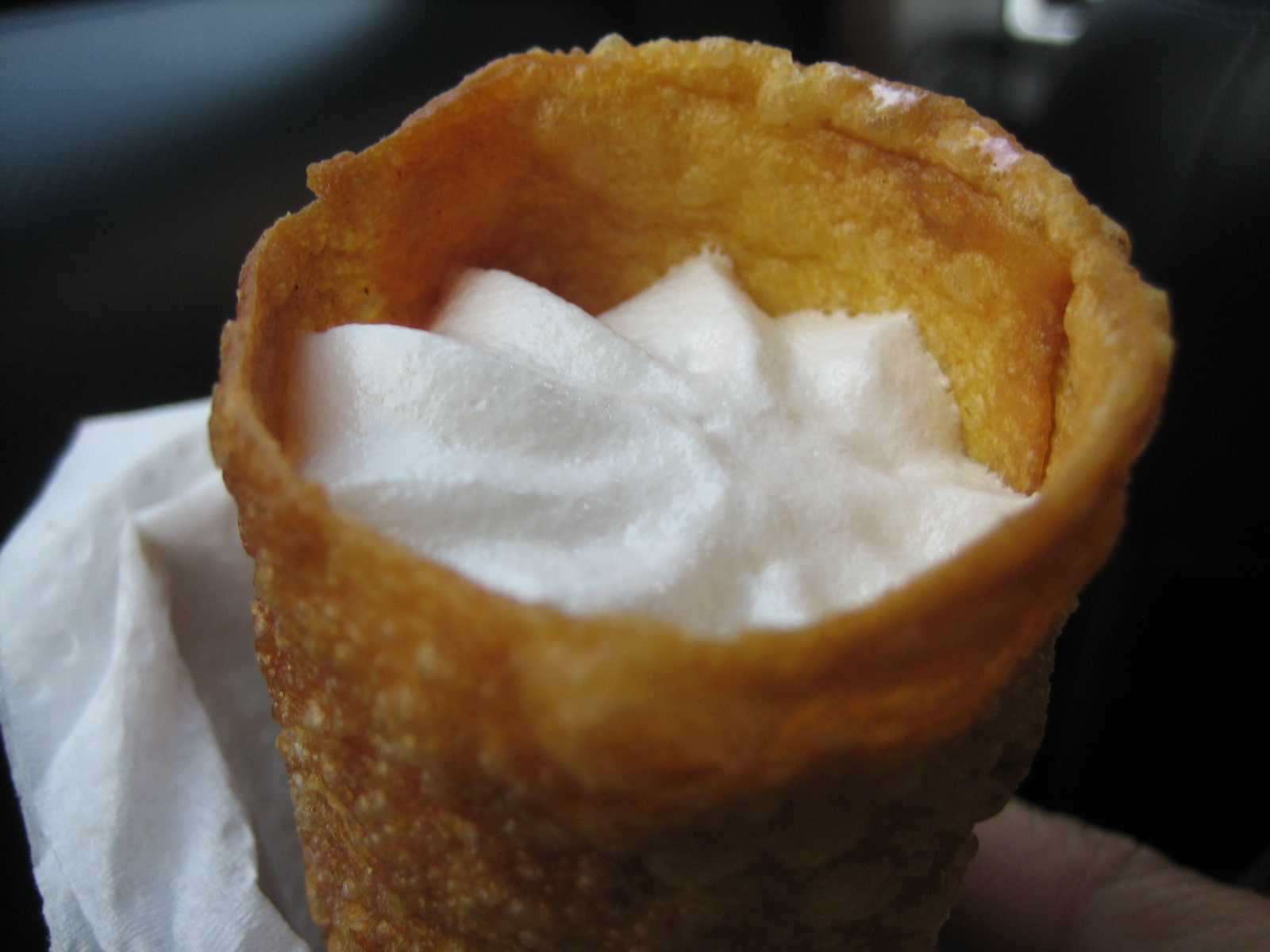
So, a few days ago, I ventured to the candy vendor who sits outside the Palacio de Hierro parking lot under a blue umbrella. (I’m guessing he hands people candy through their car windows.) Like a lot of other street candy vendors, he sells gaznates — tube-shaped pastries stuffed with meringue — and cocadas. One muégano was kind of expensive: 15 pesos, or more than a dollar.

Being a good food blogger, I meant to take my muégano home and get a photo first. But just knowing there was fried, sticky-sweet dough ball in my purse, I couldn’t help myself and bit into it right away.

Wow. This thing was dangerous. A lot of Mexican candies are overwhelmingly sweet, but the muégano seemed balanced, with the caramel taste of Cracker Jack popcorn. It was kind of like eating a syrup-soaked buñuelo that had hardened in the sun somehow.

I loved it.

My partially eaten muégano

Obviously I can’t order them every day, but I may get one again, when an alegría doesn’t suffice.

Have you tried muéganos before?

Filed Under: Streets & Markets Tagged With: candy

Guacamayas in San Miguel de Allende

February 28, 2011 by Lesley Tellez

I hadn’t spent much time in San Miguel de Allende until about a week ago, when I went for the annual writers’ conference.

To be honest, I didn’t really have a high opinion of the place — Crayton and I spent one afternoon there in 2007 and I remember feeling annoyed with all the English-speaking, the tourists in shorts, the expensive artesanía.

This time I went with a more open mind. I stayed at a beautiful bed and breakfast, Casa Luna, with one of my favorite girlfriends in the world. I took some cooking classes with the incomparable Marilau. (More on her later.) The city was much prettier than I remembered — probably the most well-preserved colonial Mexican town I’ve ever seen. The English-speaking didn’t bother me much. What bugged me more was constantly receiving flour tortillas instead of corn, because the waiters thought I’d like them more. (Flour tortillas are for the north. We eat corn in Central Mexico.)

One of my favorite snacks in San Miguel was the guacamaya, a chicharrón sandwich made on a bolillo roll. A very cool children’s book author I met, who happened to be a San Miguel native, told me about them. Apparently the sandwiches are quite popular in León.

I spotted a stand through the window of a car one afternoon and made the driver, a new friend, pull over.

I’d thought the salsa would be more like a torta ahogada, but it was much fresher, like a pico de gallo. It soaked into the chicharrón, creating this layer that was soggy in parts and crunchy in others. Somehow it tasted light, much lighter than the gringa al pastor I had the first night in town. (The gringa was awesome, by the way. But different.)

I may go back to San Miguel later this year for more cooking classes. If you’ve got any tips on interesting local foods, or if you know anything about guacamayas (like how they got their name!), I’d love to hear your comments. You can find more San Miguel food photos in my Picasa album.

Filed Under: Streets & Markets Tagged With: chicharrón

Gorditas de maiz quebrado in Querétaro

February 8, 2011 by Lesley Tellez

Crayton and I decided last-minute to go to Querétaro this weekend, with our friends Jon and Ale.

We booked our hotel the morning we left, so I didn’t have time to research where we’d eat. Thank goodness for the Querétaro marketing machine — at one of the tourism kiosks in the Centro Histórico, I found a small pamphlet decorated with cookies that listed markets, restaurants and some of Querétaro’s typical foods.

The gorditas de maiz quebrado sounded particularly interesting. They were fried discs made of coarsely-ground masa, stuffed with either chicharrón — in Querétaro it’s called “migajas” — or cheese. A wallop of lettuce went inside. Chilangos, by comparison, don’t eat lettuce in their gorditas. The masa is smooth, the same as tortilla masa. As an aside, there are endless varieties of gorditas in Mexico. Some are baked, some are fried, some are sweet. Ricardo’s dictionary devotes 2 1/2 pages to explaining their differences.

Per the cute Querétaro tourism booklet’s recommendation, we hit the Mercado de la Cruz in the Centro Histórico. Eventually we found Gorditas El Guero y Lupita.

It was a madhouse. Every seat at the medium-sized puesto had been taken, with people sitting along the bar and crowded onto benches. A queue snaked between the register and the fryer, while the owner — El Guero himself — scribbled orders on small pieces of paper. Customers who’d finished eating cried out for more — “Seven more gorditas de queso!” — and El Guero wrote down those orders too, in a messy script.

Equally impressive were the women making the gorditas, who grabbed scoops of masa and stuffed them with cheese and chicharrón, patted them thin, and tossed them into the fryer. They were focused and quick, shaping the masa for only a few seconds before moving onto the next palm-full.

The gigantic fryer

That's masa in the large bowl, and cheese and chicharrón (migajas) in the buckets


…

Read More

Filed Under: Streets & Markets, Travel Tagged With: gorditas, nixtamal, Querétaro

The wiles of the pambazo

January 31, 2011 by Lesley Tellez

The pambazo never appealed to me until a few days ago, when I was puttering around Mercado San Juan Arcos de Belén, trying to brainstorm some new snack ideas for Eat Mexico.

Pambazos aren’t exactly snacks. They’re plump, bulging sandwiches stuffed with potato and chorizo. The roll — which according to Wikipedia was originally called “pan basso,” or lower-class bread — is drenched in a guajillo-chile sauce and then fried.

I’d always placed the pambazo up there with the torta de tamal. (A fine sandwich, particularly suited to laborers and other people who aren’t going to eat for five or six hours.) But how could I call myself a Mexico City food tour operator if I had not tried the pambazo? Plus I’d worked out four times last week.

So I got one.

The woman grabbed a roll off the stack, fried it briefly, then sliced it and placed it on the grill. Once the bread was dark-golden brown and toasty, she she slathered the chorizo-potato mixture on one side. Then came the crema on top: one spoonful. Two. Three.

She pressed the sandwich together, cut it in half, y ya. Done.

This was a simple, toasted torta. And it was fantastic, actually: the crema had oozed into the potatoes and chorizo, creating this comforting, warm potato salad. The bread, not greasy at all, crunched with each bite. I’d balked at the amount of crema involved, but the crema brought everything together. You could not have this sandwich without three spoonfuls of crema. Or could you?

I briefly wondered whether could make a healthy version at home. (Potatoes and mushrooms, maybe? Yogurt instead of crema?) But that would be blasphemous. The pambazo was perfect just as it was: crema, chorizo and potatoes, and crisp, salsa-dipped bread.

Have you tried pambazos? Did you have as rapturous as an experience as I did?

Filed Under: Streets & Markets Tagged With: street food

A visit to the Teotitlán del Valle market, with Reyna Mendoza

January 21, 2011 by Lesley Tellez

The highlight of my trip to Oaxaca was the one-day cooking class I took with Reyna Mendoza. She’s a Zapotec woman who lives in Teotitlán del Valle, a small town about 45 minutes from Oaxaca City. She’s been making Mexican food by hand since she was a little girl.

Mendoza has impressive credentials. She is heartily endorsed by Rick Bayless; she’s also worked with Ricardo Muñoz Zurita and Pilar Cabrera of Oaxaca’s Casa de los Sabores. I wanted a course in Spanish, and Reyna’s class seemed like a good fit for me. We’d get to cook in her outdoor kitchen, grind mole by hand on her metate and shop at the Teotitlán market.

I showed up at her house bright and early one weekday morning, around 9 a.m. (Just a few minutes late because I actually believed the “shorcut to the Teotitlán Centro” sign off the main road.) She grabbed her straw basket and we set off for the market, which was about five minutes from her house. We passed other women in aprons and braids and rebozos, their market baskets tucked under their arms, too.

Unlike the market in Tlacolula, the Teotitlán market seemed quiet and full of locals. I only saw one woman with European features; everyone else had mocha skin, inky hair, braids and rebozos.

The market comprised two to three large, open rooms. Chiles, purple ejotes, purple tomatillos, onions and other produce lay stacked on large concrete tables. Prepared food sat in another room, with bundles of flautas and pots of rice and black beans. In the room beyond that, vendors sold herbs and roots and piles of sweet bread.

The conchas that decorate my dreams.

I want to wake up to this basket every day.

The shoppers, almost exclusively women, loaded their baskets with everything they needed for the day. (Reyna specifically mentioned that to me: cooks here prepare everything fresh daily.) People talked and laughed and greeted each other in Zapotec. I made the mistake of saying “Buenos días!” to one vendor and she looked at me strangely. Reyna murmured to me: “People speak Zapotec here.” She taught me how to say “buenos días” in Zapotec: zac xtili. (I pronounced this Sock SHEEL-ee.)

Suddenly I longed for a market basket too, and I asked Reyna if she knew where I could buy one. We walked to a stand in the next room, where I spotted a grand, oval thing with a sturdy handle, perfect for carrying a day’s worth of provisions from my local tianguis. The price was steep — 250 pesos. Did I really need this basket? I tried to picture myself walking down the street in Roma, clutching the basket amid the street vendors and rumbling peseros. It could work, I decided. I bought it and didn’t try to bargain.

We bought sweet bread to snack on, and we picked up the tomatillos, cilantro and avocados we’d need for the salsa later. I bought some purple-tinged ejotes, just because they looked kind of like dragon’s tongues.

We walked back to Reyna’s house clutching our baskets. In front of us, three women carried their provisions on their heads.

I’ll get to the cooking portion tomorrow, but here are a few more pictures of the market.


…

Read More

Filed Under: Streets & Markets, Travel Tagged With: mercados, Oaxaca, Reyna Mendoza

Christmastime at Mercado Medellín in the Colonia Roma

December 9, 2010 by Lesley Tellez

I’ve been kind of a Christmas grinch lately.

It’s not a fun time to be living in Mexico City. The traffic is twice as bad. Drivers become despots of their own car-kingdoms, leaning on their horns at any pedestrian in their way. (Even if us walkers have the light!) Christmas lights blink wildly on random street corners, part of these pop-up markets on the sidewalk. And there are no taxis available.

I had a whole post planned last week about how Christmas had turned me into a ball-busting chilanga who glares at everyone. At the end I’d asked for advice: what do I to make my spirit feel a little brighter?

I realized the answer before I could post anything. For me, getting into the spirit meant staying home and curling up with Crayton while listening to Christmas music and decorating our tree. It meant making ponche spiked with brandy. And visiting a market specifically to marvel at the Christmas items — not the hurried, in-and-out visit I normally do.

Last week I took a trip to Mercado Medellín in the Roma, which is where I buy my dried chiles and mole pastes. It’s also one of the stops on Eat Mexico’s Taco Tour.

Like nearly every market in the city right now, they’ve got piles of winter fruit for making ponche, which is the typical warm punch enjoyed during the holidays in Mexico. Dozens of piñatas and their long, papery streamers dangle from the ceiling.

Sugarcane, called caña in Spanish, is peeled and chopped used in ponche

Tejocotes, called Hawthorne apple in English, taste somewhere between an apple and a pear. They're peeled, seeded, halved and boiled until soft for ponche.

Guavas are at their freshest and most aromatic in December. They can literally perfume an entire room.

Tangerines aren't used in ponche, but they're plentiful around this time of year. They're called mandarina in Spanish.

After buying my ponche fruit, I discovered an area I’d never visited before, a hallway lined with fondas selling romeritos, bacalao and buñuelos. I asked the woman at a fonda called “Sonia” if I could have half romeritos and half bacalao, and she agreed.

Last year I had trouble getting into the whole romeritos-drowned-in-mole thing, but now the dish is growing on me. Good mole is key.

The romeritos are on the left.

A pot of bacalao from Chucho's, a fonda next door to Sonia's inside the Mercado Medellín

Buñuelos, with a pitcher of piloncillo syrup

After leaving the market, I felt much better, and I no longer wanted to kill any of the honking drivers on the streets. I even stopped at the Christmas tchotchke market and debating buying some hand-painted ornaments.

I’d still like to know: Are you feeling grinchy this year, too? What are you doing to get into the spirit of things?

Filed Under: Mexico City, Streets & Markets Tagged With: holidays

The safest way to eat on the street in Mexico City

November 18, 2010 by Lesley Tellez

A sweet, pineapple-flavored tamale from a street stand in Col. Roma

It’s a myth that eating any street food in Mexico City will make you sick.

But if you’re not used to eating on the street here, you shouldn’t just pick any stand. One of the most common questions I get through my Eat Mexico tours is: “How do you choose where to take us?”

Here are the guidelines I use when planning our Eat Mexico tour routes.

1. Pick a street food stand that looks crowded. This means several people standing up and eating in a cluster around the stand. If the stand is empty, and you don’t have a personal recommendation from someone else who’s eaten there, do not eat there.

2. Glance around and see if the stand looks clean. Are there stains everywhere? Dirty plates and napkins? If so, pass. I also pass on places where the food just sits in one big pile, as opposed to clean clay pots, or tupperware or stainless steel containers.

Plastic buckets are a common way to store various quesadilla or taco fillings in Mexico City. The ones above are quite large, which denotes high volume, which means the place most likely has great food.

3. Who takes the money? It’s a good sign if the person preparing the food and the person accepting payment are two different people. Smaller stands can’t afford this luxury, so make sure they place a piece of plastic over their hands when receiving cash or change.

4. The food must be freshly prepared. Some stands in Mexico City prepare a lot of food beforehand, and it just sits out. They don’t even necessarily warm it for you — it just goes from the container right into your tortilla. (My one exception here is tacos de canasta, which by definition sit out all day, steaming in a basket. They’re still really good.) These stands won’t automatically make you sick, but they just don’t taste as good. It’s a much tastier experience to watch the taquero make your taco right in front of you, or to watch the older woman pat the masa into a tlacoyo.

A woman prepares fresh quesadillas and tlacoyos at a street stand in Col. Roma

5. Feel free to make small talk while you eat, if you speak Spanish. Most stand-owners are nice and they’ll answer your questions, especially if you’re a foreigner. Ask, “Cuántos años llevan aquí, en este esquina?” which means, “How many years have you been here, at this corner?” Many stands have been on certain corners for decades. If you’ve found the tlacoyo stand with the little old woman with the gray braids who says, “I’ve been here 40 years,” you’ve struck gold.

6. Go during peak hours. This helps you get a better idea of which stands are the most crowded. In Mexico City, peak street food hours are generally 10 or 10:30 a.m., or 2:30 to about 4 p.m. (And then perhaps 8 p.m., when folks are getting off work.) Be aware that if you’re searching for street food at 6 or 7 p.m., some stands are closing up for the day, and you’re going to get the dregs of their daily product.

Do you have any tips you use when eating street food, either here or elsewhere? Feel free to share below.

Tacos de canasta with salsa verde, from a street stand in Condesa

Filed Under: Mexico City, Streets & Markets Tagged With: Eat Mexico, street food

Fresh chamomile tea, and a new Mexico City organic market

November 10, 2010 by Lesley Tellez

One of the perks of living in Mexico City is that fresh chamomile is available almost everywhere. Of course, when I first moved here, I had no idea what it was — I thought vendors were selling a miniature type of daisy. Figured it was some fresh herb that cleaned out your kidneys, or something.

Only recently did I realize that those daisies were actually wild chamomile. I’ve been trying to kick my coffee habit, so I bought a bunch for the first time on Sunday at the Mercado el 100, a new weekly outdoor market that specializes in organic products.

The market launched a few Sundays ago in Roma, and then it moved to Parque México in Condesa. It’ll move again this weekend to Casa de Francia in Col. Juárez.

The market is fairly small, but it’s got a decent variety of products for sale — two vendors sell fresh produce (scored some gorgeous basil at one stand a few weeks ago), while the rest offer ready-made goods such as tortillas, jams, dried xoconostle, agave syrup, coffee.

The neat thing is that there isn’t any other outdoor market like this in the city. The tianguis sells produce and other products, but most of it comes from the Central de Abastos, which gets in turn gets it from large industrialized farms in Mexico. Nick Gilman has a detailed article about the Mercado el 100 on his blog, if you want to know more.

As for the chamomile tea: the fresh version has a much grassier, herbal flavor than the dried versions I’ve bought in the store. Just be careful not to add too much, as chamomile is a mild laxative.

Fresh Chamomile Tea
Makes about 3 cups

Note: I’ve heard some folks say they throw in the entire plant into the pot, and not just the flowers. I tried it this way and the resulting tea turned out green! And it tasted much more strongly of grass. So I prefer the flowers only. The taste obviously depends on your palate, but a good rule of thumb is one tablespoon of flowers per cup of tea.

2 tablespoons fresh chamomile flowers, rinsed
About 3 cups of water

Boil water and add chamomile flowers. Let boil for one to two minutes, turn off the flame, and then steep for five more minutes or “hasta que tenga su colorcito,” as the vendor told me. (Translation: “Until it has it’s little color,” which means until it’s turned a deep yellow.) Strain the flowers and serve.

Filed Under: Mexico City, Streets & Markets

Real huitlacoche, in all its spooky beauty

August 13, 2010 by Lesley Tellez

I was so excited to find this yesterday: a piece of huitlacoche, real huitlacoche, with the corncob still attached!

Usually vendors in Mexico sell huitlacoche (a corn fungus, obvs) in plastic bags, having already plucked the plump nuggets off the corncob. I bought this from an old woman outside Metro San Cosme, in the Colonia San Rafael. She had huitlacoche, nopal and a few bunches of herbs spread out on the sidewalk. Everything came from Toluca.

Fresh huitlacoche is a rare find in the United States, by the way. According to the cookbook Tacos, which I just stumbled on in Google Books (otherwise, I would not normally read a taco cookbook, because tacos are not dishes in themselves, they are a way to eat something) the U.S. government requires a special permit to grow huitlacoche, since it’s a fungus and the spores are disseminated through the air. Heaven forbid too much American corn becomes contaminated — how would we fulfill our corn syrup needs?

Unfortunately I won’t know what corncob-attached huitlacoche tastes like. I’m leaving town tomorrow for two weeks and won’t be home for most of today. Yesterday I gave my spooky huitlacoche to Lola, so she could enjoy it. She said she planned to make “unos ricos tacos.”

Filed Under: Streets & Markets Tagged With: huitlacoche

« Previous Page
Next Page »

Primary Sidebar

Who is Mija?


Mija is Lesley Téllez, a writer, mom, and culinary entrepreneur in New York City. I lived in Mexico City for four years, which cemented my deep love for Mexican food and culture. I'm currently the owner/operator of the top-rated tourism company Eat Mexico. I also wrote the cookbook Eat Mexico: Recipes from Mexico City's Streets, Markets & Fondas.

Search this site

Buy My Book On Amazon

Eat Mexico by Lesley Tellez

Get The Mija Chronicles in your inbox

Enter your email address:

Delivered by FeedBurner

Read my old posts

Copyright © 2026 · Foodie Pro & The Genesis Framework