• Skip to main content
  • Skip to primary sidebar

The Mija Chronicles

Mexican food and culture, on both sides of the border

Lesley Tellez

Instagrammers I love: Mexican Food Porn

October 11, 2013 by Lesley Tellez

Tacos Leo in Los Angeles. Photo by Mexican Food Porn.

Tacos Leo in Los Angeles. Photo by Mexican Food Porn.

Mexican Food Porn’s photos make me ache for Mexico City.

His images — shared both on Tumblr and his Instagram account — capture Mexican food’s rich colors and layers, and sometimes its chaos. Chilaquiles bask in a messy lagoon of cream; a shrimp taco with a harsh sheen of cheese shines a little too brightly under white lights. (Haven’t we all eaten that shrimp taco, maybe a little too late at night?)

The owner of the account is a 27-year-old Mexico City resident, who spent five years living in California’s Bay Area. He was born in Monterrey, Mexico.

MFP agreed to answer some questions for me via email, but he said he preferred to remain anonymous, as he’s actively pursuing other interests unrelated to photography and food.

Here’s more from him. (Disclaimer: he sometimes uses stronger language than I generally do on this site.)

Q: Why Mexican food and not some other kind of food?

Tacos guisados in Mexico City. Photo by Mexican Food Porn.

Tacos Guisados in Mexico City. Photo by Mexican Food Porn.

Ask any Mexican who leaves the country for any period of time, what do you miss the most? Politics? Traffic? No… people miss their food. The blog was formed in San Francisco, basically because of my nostalgia for Mexican food and culture. During my five years in SF, I noticed that while the Bay Area has some decent Mexican food spots, I was always longing for more authentic stuff.

While exploring, I realized that Mexican food, or any food really, is marked by geography and culture. A taco in L.A. is way different from the ones in S.F. A burrito in SF is way different than in San Diego. The possibilities are endless, and I tried to embrace everything. One of my favorite burritos? Señor Sisig California burrito. A fusion between Filipino and Mexican/Californian, stuffed with French fries. Is it “authentic”? Nope, but who cares? It’s a niche on its own.

Also, Mexicans tend to “Mexicanize” anything in their way, especially food. Go to a Japanese restaurant in Mexico and it’s not uncommon to see bits of jalapeño in your soy sauce. Hot dogs? Wrap them in bacon and top them with grilled onions and serrano peppers. Fettuccine with creamy chipotle… so what is truly Mexican cuisine?

Fettuccine with creamy chipotle sauce. Photo by Mexican Food Porn.

Fettuccine with creamy chipotle sauce. Photo by Mexican Food Porn.

Finally, more than Mexican food I want to emphasize one of life’s greatest pleasures: sitting down, ordering drinks and enjoying a meal with loved ones. Doesn’t matter if it’s Chinese, high-end Indian or drunk greasy tacos at 4 a.m.

Q: What was the best thing you ate recently? 

A barbacoa taco with avocado cream, from Pujol, Mexico City. Photo by Mexican Food Porn.

A barbacoa taco with avocado cream, from Pujol, Mexico City. Photo by Mexican Food Porn.

Pujol in Mexico City. I went for the first time a couple of weeks ago and it was simply amazing. The food, the decor, the concepts. It was a great experience. From that entire meal, the barbacoa taco with a tortilla made with poblano peppers and the Mole Madre were fucking unreal. I forgot I was sitting in a fine dining establishment. Enrique Olvera is redefining our cuisine in amazing ways.

Another amazing spot? La Panga del Impostor in Guadalajara, a little informal hip seafood joint run by Chef Antonio de Livier and restaurateur Javier Rodriguez. Everything in the menu is jaw-droppingly good. You happen to be in Guadalajara and have a near-death hangover? Go there.

A scallop, octopus and shrimp tostada from La Panga de Guadalajara. Photo by Mexican Food Porn.

A scallop, octopus and shrimp tostada from La Panga del Impostor.

Q: You’re stranded on a desert island and can only take 3 antojitos. What are they?
This is a cruel question. Only 3? 

– Guacamole with pork cracklings to scoop 
– Tacos de carnitas
– Tortas – Cemitas 

It’s interesting, because seafood isn’t considered to be in the antojitos realm, but I think they totally should. And since I am in a deserted island: 

-Aguachile 
-Coctél Vuelve a la Vida 
-Oysters. Oysters and more oysters. 

Extra points: 
-Mezcal, tequila and ice cold beer. (Better be hydrated.)

Q: Do you cook?
I try to as much as I can. I tend not to measure things, I just throw things around, scoop with my finger to taste. For me cooking has been lately some sort of laboratory-style therapy. Chopping things, letting things simmer, smells… just simply engaging all the senses and testing. It’s pretty relaxing. That said, I don’t think I would last 3 minutes as a line cook, but I can feed a small group of people.

Mexican Food Porn's homemade tomatillo salsa.

Mexican Food Porn’s homemade tomatillo salsa.

Q: Have you found any Mexican food dishes particularly hard to photograph? 
Not really. As of now most of the food pictures I take are with my iPhone. I guess the challenging part is to have a good angle and right lighting. At times it’s hard to just whip out the phone and take pictures. You know, just holding your plate of tacos, or at a restaurant. Moving around the plate and other eaters. I’m getting better dealing with the “what the fuck are you doing?” looks.

Q: Chile de árbol or habanero?
Lately I have been eating a lot of habanero. But how can you say no to chile de árbol? 

Filed Under: Interviews Tagged With: Photography, tacos

Being home in New York City, redux

September 24, 2013 by Lesley Tellez

The Viva la Comida street food festival in Queens, held Sept. 20, 2013, not too far from my house.

The Viva la Comida street food festival, held in my Queens neighborhood on Sept. 20.


Remember when I posted in June about not feeling like I was home?

That’s changing. More and more, I’m feeling like I belong here, no doubt because I’ve spent my first solid 30 days in New York without jetting off to somewhere else. (I had to double-check that on my calendar — had I really not spent a straight month in New York since January? Yes, it’s true.)

In the past month, I have…

1. Gotten off the subway, and a growing number of times recognized east from west. A few days ago I even corrected Crayton: “Are you sure Ninth Avenue is this way?”

2. Got a haircut I liked.

3. Ran into a Queens friend randomly at a restaurant in the East Village.

4. Gotten over my longing to take cabs and walked the streets on purpose, because the city is stunning on summer nights when there’s a breeze. You can look up at the fire escapes criss-crossing the buildings and the skyscrapers all lit up and glowing, and not have to worry about bumping into anyone.

5. Distinguished the sounds of the local and express trains at my subway stop, which in turn determines whether I need to run as I’m approaching the turnstile.

6. Relished how fast New Yorkers walk, and the fact that you can say “Excuse me!” to someone in your way in a loud and urgent tone, and generally no one takes offense. (Or at least I don’t think they do — I’ve been “excuse me”-ed often, so I’m guessing it’s a normal thing.)

7. Had my first Queens Chinese breakfast. Yeah, zhaliang!

8. Decorated our apartment walls, installed a stainless steel worktable in our kitchen, and bought fresh flowers for all the sunny rooms in the house.

9. Attended the Viva La Comida street food festival in our neighborhood, which made me realize all over again why we picked Queens. Thanks for organizing, Jeff.

10. Ate a lovely dinner on a friend’s rooftop in Hell’s Kitchen.

Dining on the roof in Hell's Kitchen, courtesy of my friend Shaw.

Dining on the roof in Hell’s Kitchen, courtesy of my friend Shaw.


I’m excited to be here, and excited about the opportunities ahead. Thanks again for sticking with me.

Filed Under: Reflections

Roberto Santibañez’s sweet-and-crunchy grape guacamole

September 18, 2013 by Lesley Tellez

Grape guacamole

I’m generally an guacamole purist. Or really, an avocado purist: pass me a few slices of ripe avocado, a sprinkle of salt and a crispy tortilla, and I am perfectly happy. But when Roberto Santibañez’s PR team passed me a recipe for grape guac a few weeks ago — smooth and crunchy, it promised; spicy and cool at the same time — I thought, oh hell, why not.

The thing is, this summer was hot in New York. Like sweaty Texas hot. Sit-on-the-air-conditioner hot. Now the temps have cooled off, but when it was hot, all I could think about was cold things. Like grapes straight from the refrigerator.

The grapes in this dish, thankfully, don’t overshadow the avocado at all. They actually add a light fruitiness and a toothsome texture that I didn’t know could exist in guacamole. You really get all the flavors in one here: sweet, salty, acidic, spicy.

I baked up some corn tortilla chips (my usual way is to cut tortillas into triangles with kitchen shears, then bake them at around 400F until golden brown) and munched happily through the afternoon.

Recipe below, while you can still find grapes at the stores. Also, if anyone’s wondering, I’ve found fantastic Mexican avocados at bodegas in Queens.

Grape Guacamole
Adapted slightly from Roberto Santibañez’s recipe
Serves at least four as an appetizer

Note: I’ve listed two types of grapes here because that’s what the original recipe called for, but I don’t see any particular reason to use two. You’d still get the sweetness and texture with just one variety. The original recipe also called for 3 avocados, but since I was only feeding Crayton and me, I scaled down.

I also made this in the molcajete, which allows you to create a paste out of the onion/chile mixture. Sort of like this:

Jalapeño and onion paste in the molcajete

If you plan to mix yours with a good old-fashioned bowl and spoon, I’d make sure to finely chop the onion and jalapeño, so you don’t have any big onion or chile parts sticking out.

Ingredients

2 tablespoons chopped white onion
1/3 of a large jalapeño, with seeds, chopped roughly (you can also use serrano)
2 ripe HaasHass avocados
10 large red grapes, cut into quarters
1/3 cup small green grapes
1/2 teaspoon kosher salt, plus a smidge more (if using table salt, start with less)
juice of 1/2 large lime (or to taste)

Directions

In a molcajete, if you’re using one, add the chopped onion, jalapeño, and just a pinch or two of salt. Grind into a paste. (Alternately, you can mix the items in a regular mixing bowl.)

Cut the avocados in half, remove the pit, then cut each half into cubes. Add to chile-onion paste and mix. You can use the back of a spoon or the pestle (tejolete) from your molcajete to crush some of the cubes a bit, just so it doesn’t look so uniform and perfect. Stir in the grapes, reserving some for the garnish if you like. Taste and add lime juice, and more salt as needed. Serve with chips, tortillas, or whatever you want.

Filed Under: Recipes Tagged With: appetizers, avocado

Chef Roberto Santibañez on grapes and his new Brooklyn restaurant

August 26, 2013 by Lesley Tellez

Chef Roberto Santibañez

Chef Roberto Santibañez

When people ask me for my favorite Mexican restaurants in New York City, Fonda is typically high on my list.

The restaurant’s two locations (in Park Slope and the East Village) are comfortable and cozy, and the menu sticks closely to Central Mexican classics, with some New York flair. I’ve tried and loved Fonda’s cochinita pibil and the braised duck tacos with tomato-habanero cream sauce; the tlacoyo with spring-pea spread and mushrooms is currently on my must-try list.

Chef Roberto Santibañez, who grew up in Mexico City, opens a new restaurant in Brooklyn this fall, after spending the previous few years writing Mexican cookbooks.

Santibañez recently paired up with the California Table Grape Commission on a promotional campaign. I snagged a few minutes with him last week to talk about both grapes and his new place. Here are a few excerpts from our conversation.

What’s so exciting about grapes, anyway?
I think they’re incredibly versatile and useful. I use them a lot, too, in our cooking. They add texture. To me a grape is a very balanced ingredient all in itself, even if it’s a little tart, it’s a great thing to eat. I love them. And you can use them in guacamole and they give crunch and texture. You can cook with them, too. You can make a sauce and cook the grapes in it and it’ll be delicious. And you can roast them.

Grapes aren’t traditionally used in Mexican cooking, though, correct?
It’s an ingredient we always eat, but it’s not something that’s used a lot in cooking, except when it comes to guacamole. They do add grapes to guacamole in the state of Guanajuato. They add grapes, peaches, pomegranate.

Can we go back to the roasting grapes idea? That sounded really interesting.
You can make a salsa with grapes. You can roast grapes and grind them up with garlic and chile de árbol or a chipotle. And if you think of that fruit with everything it provides to the dish, it’s the same as a tomatillo or tomato. It’s actually providing fruit, tartness and sweetness.

You’re opening a new restaurant in Brooklyn, selling Mexican tapas. What is that?
It’s botanas. We’re going to do small plates to share. We’re going to have breads, jamones, chorizos, morcilla. Aceitunas and all that stuff. And there’s going to be great red wines, great aiolis, dips. It’s going to be very worldly, not necessarily focused on Mexico.

Any plans to write another cookbook?
I do. I just wanted to purposely take a little bit of time off, because as you know, right after publishing Rosa’s New Mexican Table, I immediately got into Truly Mexican, and then immediately into Tacos, Tortas and Tamales. I was just sort of taken back a little bit and thought I needed to focus on what’s really bringing me home. It’s our business. Books are fantastic for exposure and they give you an incredible amount of professional satisfaction. But they don’t necessarily make a lot of money. So I needed to regroup with myself and wait a little bit. But there’s a very nice project that I have in the back burner, about Mexico City.

You’ve been in the restaurant industry for awhile now, particularly in New York. What’s one thing you’ve noticed about Mexican food now that’s different when you arrived?
It’s become more and more available. But the wonderful thing about it is not just that it’s become availble in one kind — it’s become available at the super higher-end, lower-level, mid-level. It’s no longer that Mexican food in New York had only a few either very high-end or low-end establishments. Now you have a gamut of them. You can see all sorts of shades and textures, and that’s a wonderful thing.

I have to say, I’m intrigued by this idea of using grapes as tomatoes. I guess I’ll just them on the comal and hope they don’t explode?
Yes. Or put them on the toaster oven, like you would with grape tomatoes, if you’re going to make a salsa. It’s delicious.

Coming next: Roberto Santibañez’s recipe for grape guacamole.

Filed Under: Interviews

Drinking homemade pulque — and visiting a real pulque farm — in Tlaxcala

August 6, 2013 by Lesley Tellez

Pistachio and guava pulque at La Pirata, Col. Escandón, Mexico City.

Pistachio and guava pulque at La Pirata, Col. Escandón, Mexico City.

My first pulque experience happened at La Pirata, a pulquería in the Escandón neighborhood where locals go to drink and play dominoes. My friend Jesica had warned me that pulque was an acquired taste, but I didn’t realize how much.

The drink was thick and viscous, like baba de nopal. When we took sips, little slimy strings stretched from our lips to the glass. It tasted slightly sour. Kinda funky. (Kinda like… rotting food?) The guava flavor was better. And the celery, even better: like a fresh, bright jugo, accented with heat from the chile-encrusted rim.

From then on, my love affair with pulque didn’t grow, but pulque culture fascinated me. This drink, made from fermented maguey sap, contained thousands of years of history — priests drank it in pre-hispanic times for ceremonial purposes, and it rode a boom of popularity through Mexico’s viceregal years. Pulque was currently booming now with young chilangos. I wanted to know: how was pulque really made? Where did pulque come from before it arrived at the bar?

Finally, in early July, with the help of my friend Mojdeh (she runs a wonderful Mexico City-based tourism company called Journeys Beyond The Surface), my Eat Mexico guides and I were able to take a trip out to Tlaxcala. Mojdeh arranged for us to visit Nanacamilpa, a town in eastern Tlaxcala state whose agave farms supply at least one pulque bar (Las Duelistas) in Mexico City. It’s also home to a large operation that exports to the United States, although we didn’t end up visiting them.

We left Mexico City, bleary-eyed, at 6:30 a.m. A few hours later — after some windy highway roads, a dirt road through a forest, and a short, steep, rocky incline — we arrived at a small farm. The place was beautiful. Fields of corn stretched into the hillside, and neat rows of agave splayed their wild medusa hair in all directions.

The men here made pulque for local consumption only. They also planted quelites, apples, potatoes and fava beans.

A field of maguey in Nanacamilpa, Tlaxcala.

A field of maguey in Nanacamilpa, Tlaxcala.

A corn field in Tlaxcala, Mexico.

The Nanacamilpa farm corn field.

Maguey plants

A field trimmed with agave in Tlaxcala, Mexico.

A field trimmed with agave in Nanacamilpa, Mexico.

Maguey plant

One of the workers there, Don Miguel, graciously attended us. He was a rough-hewn man in a leather jacket and rubber boots. (A bunch of wild herbs peeked out of one of his pockets, which we later found out were for his favorite type of tea.)

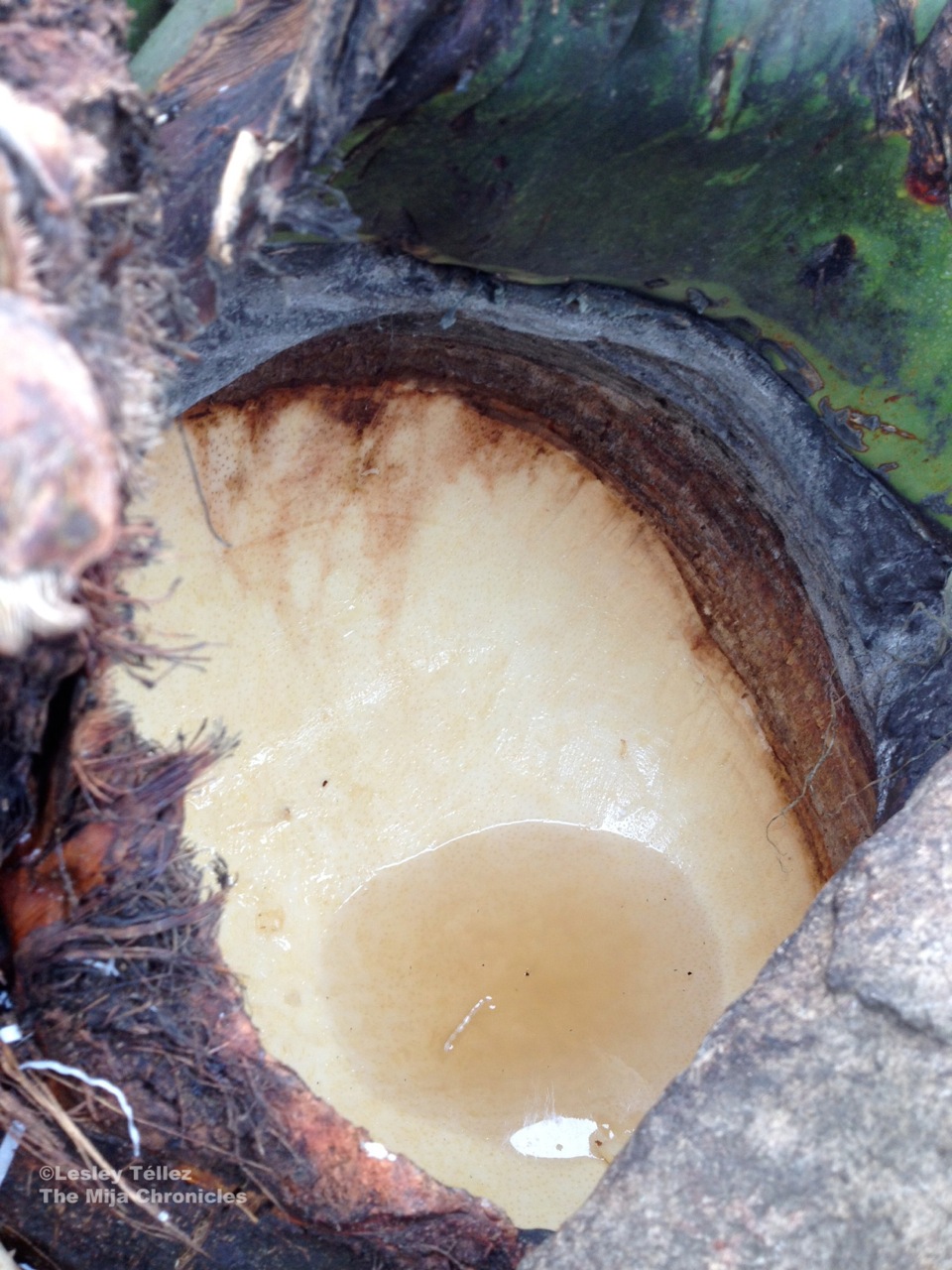
He showed us around, explaining which agaves were ripe for harvesting, and how he’d eventually cut out a small piece of their core and scrape the inside, so the plant would start to secrete its own juices.

This juice would be transferred to a large fiberglass bin, where it would mix with a bit of the pulque starter, and then left to ferment. The liquid turned into pulque after about four hours, Don Miguel said. It would generally last up to eight days. There were no other chemicals or additives involved.

Natural sap, or aguamiel, from the core of the maguey plant.

Natural sap, or aguamiel, from the core of the maguey plant.

A vat of fresh pulque in Nanacamilpa, Tlaxcala.

A vat of fresh pulque in Nanacamilpa, Tlaxcala.

The vat of "starter" pulque, which is used to jump-start the fermentation of the other tubs.

The vat of “starter” pulque, which is used to jump-start the fermentation of the other tubs.

We wandered among the apple trees, the fruit dappled with dew in the chilly morning air. We met a few of the pigs. (From afar.) Don Miguel offered us a taste of lenguas, a type of quelite that grows like a weed on the farm. They reminded me a little of chivitos.

Quelites de lengua, which are delicious raw.

Quelites de lengua, which are delicious raw.

I took way too many pictures of these apples -- couldn't help myself.

I took way too many pictures of these apples — couldn’t help myself.

Paco loving on the land.

Paco loving on the land.

At the end of a few hours, he gave us some more small souvenirs: a gorgeous wild mushroom, known locally as “yema de huevo,” and a fresh mixiote, or the papery skin of the maguey leaf. The latter is used to steam meat or vegetables in Mexican cooking, and is usually wrapped around some sort of guisado.

To peel the mixiote, Don Miguel first climbed inside a maguey plant — literally; they’re that big — and then searched for the proper penca. He saw one and then gently tugged on its papery outer layer.

Don Miguel peels back the outer skin of the maguey leaf, known as the mixiote.

Don Miguel peels back the outer skin of the maguey leaf, known as the mixiote.

Peeling off the mixiote, or outer skin of the maguey leaf.

Another view of the mixiote, as it’s freed from the leaf.

This papery skin is almost pulled off entirely now.

Almost done…

Handing over the fresh mixiote leaf to Lulu, who's going to take it home and make fresh mixiotes, or steamed packets filled with veggies or meat.

Handing over the fresh mixiote leaf to Lulu, Paco’s wife.

Awestruck at the size of the mixiote!

Awestruck at the size of the mixiote!

Lulu, Paco's wife, poses with Don Miguel.

Lulu and Don Miguel.

A wild "yema de huevo" mushroom in Tlaxcala, Mexico.

A wild “yema de huevo” mushroom in Tlaxcala, Mexico.

Another view of the yema de huevo mushroom.

Another view of the yema de huevo mushroom.

Of course, we couldn’t leave without trying the pulque. I’d hoped it would be the best pulque I’d ever tried, but it wasn’t. It wasn’t bad, either — just the same thick, viscous, sort of tart drink I’d had before. This one, however, didn’t smell bad. It smelled like plants and yeast. I drank about half a water bottle’s worth (there were no cups there), and Don Miguel promptly filled up my bottle again for a second helping. I’m not sure if it was the cold air or the fact that I hadn’t slept, but finishing up the pulque, I was, as they say in Mexico City, “happy.”

We ended our visit to Nanacamilpa with lunch at a local fonda, which had been arranged by Mojdeh’s friend Gloria. There was only one table, so we crammed together in a spot not too far from the comal (which is actually the best seat in the house). Two women made us plates overflowing with tlacoyos, filled with alberjón as is typical in that area of Mexico, and various guisado-filled quesadillas.

Quesadillas filled with various guisados -- tinga, mushrooms and picadillo -- at a small fonda in Nanacamilpa.

Quesadillas filled with various guisados — tinga, mushrooms and picadillo — at a small fonda in Nanacamilpa.

Tlacoyos filled with alberjón in Nanacamilpa, Tlaxcala.

Tlacoyos filled with alberjón in Nanacamilpa, Tlaxcala.

I’m already thinking about going back. We spent half the day there and we didn’t see the market, or visit the larger pulque manufacturer who exports to the U.S. Next time! And next time I’m going to Hidalgo, too — there’s another pulque world that I haven’t explored.

Filed Under: Pulque & Mezcal, Travel Tagged With: pulque, quelites, tlacoyos, Tlaxcala

A photo tribute to Mexican corn

July 31, 2013 by Lesley Tellez

Criollo corn in Milpa Alta, Mexico City.

Criollo corn in Milpa Alta, Mexico City.

There’s a saying in Mexico: sin maíz, no hay país. It means without corn, there is no country.

This isn’t really an overstatement — corn has been domesticated in Mexico since at least 2,500 B.C., and it’s still the most important ingredient in the Mexican diet. Corn is used in everything from tortillas to soups and beverages, and the husks (and occasionally fresh corn leaves, when in season) are used to wrap tamales. I’ve even had charred cornsilk in certain types of atole.

Mexico is connected to corn in a way that I can’t fathom as an American who grew up in California. But living in Mexico for four years, I developed a deep appreciation for corn and its history, and its array of colors and textures. Taking pictures of Mexican corn seemed like a natural thing, in my eyes. How else do you capture a thing of beauty?

Here’s a small selection of corn photos from my archives. Feel free to share your favorite corn dish in the comments!

Shedding the papery skins of dried blue corn, to prepare it for nixtamal

Shedding the papery skins of dried blue corn, to prepare it for nixtamal

Sopa de milpa -- corn, squash, and squash blossoms -- at a restaurant in Puebla.

Sopa de milpa — corn, squash, and squash blossoms — at a restaurant in Puebla.

Elote cacahuazintle, a variety of corn that's often dried and used in pozole.

Elote cacahuazintle, a variety of corn that’s often dried and used in pozole.

Nixtamalized corn -- that's dried corn treated with calcium hydroxide -- in Hidalgo, Mexico.

Nixtamalized corn — that’s dried corn treated with calcium hydroxide — in Hidalgo, Mexico.

Purple corn husks!

Purple corn husks!

Elote desgranado, or fresh shucked corn, at the Tuesday market in Santiago Tianguistenco, Estado de México.

Elote desgranado, or fresh shucked corn, at the Tuesday market in Santiago Tianguistenco, Estado de México.

Fresh huitlacoche, still on the cob, also at the Tuesday Santiago Tianguistenco market.

Fresh huitlacoche, still on the cob, also at the Tuesday Santiago Tianguistenco market.

Blue corn esquites with epazote in San Pedro Atocpan, Mexico City.

Blue corn esquites with epazote in San Pedro Atocpan, Mexico City.

Fresh, shucked criollo corn in Milpa Alta, Mexico City.

Fresh, shucked criollo corn in Milpa Alta, Mexico City.

Salting elote near the Alameda Central, Mexico City.

Salting elote near the Alameda Central, Mexico City.

A huitlacoche quesadilla, mixed with corn, at a street stand in Mexico City.

A huitlacoche quesadilla, mixed with corn, at a street stand in Mexico City.

Corn husks drying under the sun, in Teotitlán del Valle, Oaxaca.

Corn drying in the sun in Teotitlán del Valle, Oaxaca.

Reyna Mendoza toasts corn on a comal, in Teotiitlán del Valle, Oaxaca

Reyna Mendoza toasts corn on a comal, in Teotiitlán del Valle, Oaxaca

Grilled elotes at a street stand in Mexico City.

Grilled elotes at a street stand in Mexico City.

A mural depicting corn stalks in Cacaxtla, a Mesoamerican city in Tlaxcala that flourished between the 7th and 10th centuries.

A mural depicting corn stalks (with human heads for the ears!) in Cacaxtla, an archaeological site in Tlaxcala that flourished between the 7th and 10th centuries.

Filed Under: Streets & Markets Tagged With: corn, photo essay

For those hot summer days: agua mineral preparada

July 23, 2013 by Lesley Tellez

Agua mineral preparada

I have a guest post today from my friend Macarena Hernández. She told me this story while I was hanging out with her in San Antonio recently.

Agua mineral preparada is one of my antojos. They’re very easy to find in the Rio Grande Valley, and along the border, at drive-through stores. Depending on where you go, they’re made differently. Some people put chamoy in them. Others, like at my favorite drive-through in Palmview, Texas, they actually put in stalks of celery, long shreds of carrot and dill pickles — like hamburger dill pickle slices. It’s really good.

On top of that, obviously, they put lemon, chilito (I prefer Tajin) and salt. And on top of the styrofoam cup lid, they put small cubes of jicama with sal, limón y chile, with toothpicks. So you get a little jicama salad on top of your agua mineral preparada. My family, for the most part, loves agua mineral preparada, especially after carne asadas, when we’ve had too much red meat, too much arroz and frijoles. It feels like a good digestive drink.


When I make it at home, I don’t complicate it for myself. I buy Topo Chico. I’m so partial to Topo Chico because the carbonation levels are just right. (Lesley interjects: IT’S INSANE.) It’s insane. And I don’t think you can have an agua mineral preparada without insane levels of carbonation. I’ve tried it with Perrier or whatever, the American ones, and it just wasn’t an agua mineral preparada. No matter how much limón or salt or chile I put in there it didn’t work.

Everyone likes their agua mineral preparada differently. It really depends on how much limón, sal and chile you can take. Depending on who I’d make it for in my family, the drink could look orange, or it could have just a few speckles of chilito and salt. And then I mix it gently, because I don’t want it to lose any carbonation. I like to drink it with a straw — it just goes down better.

If anyone’s visiting me, this is one thing I have them try. Not everyone likes it. If you don’t like salty, lemony, spicy drinks, you’re not going to like this. My personal favorite raspa is a diablito, which is basically lemon juice, salt and chile, so for me it’s basically a mineral water version of a raspa de chile limón.

[Lesley interjects: I think this tastes like a cross between a limonada and a michelada, without the beer. Or it tastes like these fruit salads that you have in Mexico, with the cucumber and jicama with lime and chile powder. It has that sort of freshness to it.]

Agua Mineral Preparada
Serves 1

Macarena’s notes: For the mineral water, I don’t recommend anything except Topo Chico. (I like Peñafiel, but only as a thirst quencher, not for my agua mineral preparada. And I have tried all kinds — even making this in Europe. They’re too flat. If Topo Chico is reading this, they should send me cases. I do spend a lot of money on Topo Chico mineral water.)

You can find Topo Chico and Tajin in South Texas at almost any HEB. Note that Tajin does have salt in it.

Ice is essential. This drink needs to be cold.

Ingredients

1 cup of ice
Juice of 2 yellow lemons
Juice of 1 good-sized lime (not key lime)
1 6.5 ounce bottle Topo Chico
Tajin (I use about 9 shakes of the Tajin bottle — this might be too much; start with less and taste)
Salt to taste

Optional garnishes:
Jicama cubes
Sliced dill pickles
Thinly sliced carrot sticks
Thin slices of celery
1 or 2 saladitos (dried, salted plums or apricots)

Directions

Fill a pint glass with ice. Add citrus juice. Pour in Topo Chico, and then the Tajin. (If adding saladitos, add at this point, before the salt.) Taste for salt, add to your preference, then add jicama, dill pickles, carrots and celery, if using. Stir gently to preserve the carbonation levels in the drink.

Macarena Hernández, who grew up in La Joya Texas, is a professor at the University of Houston- Victoria and a multimedia journalist.

Filed Under: Recipes Tagged With: drinks, Recipes, Rio Grande Valley

Cantonese food at Shun Wang in Elmhurst

July 17, 2013 by Lesley Tellez

Shun Wang restaurant in Elmhurst. Photo by Yelp user PeterK.

Shun Wang restaurant in Elmhurst. Photo by Yelp user Peter K.

Every time I’d walk by Shun Wang, a Chinese restaurant near my house in Queens, my mouth opened a little. Caramel-brown, glistening ducks hung on a hook inside the kitchen, next to what looked like a chunk of pork belly. I’d want to stay and gawk, but usually some surly Chinese dude in a grease-splattered apron was hanging out outside, smoking a cigarette. So I’d look and hurry on, down into the subway, the laundromat, the hardware store.

Shun Wang was always crowded. But what did they serve? It wasn’t clear. Bright construction paper signs in the window showed Chinese characters only. The only other English item was its health sanitation rating, a piece of white paper taped to the window. It was a C.

“You have to try hard to get a C!” my friend said, when I told her about the place. “No really. You have to try HARD.”

I could overlook the sanitation thing. (I lived in Mexico.) The place was almost always crowded, so I went one day with my friend Jeff.

The duck looked beautiful, shining on its oval plate, already cut into pieces. The skin was crackling and crisp, but the meat was a little rubbery. Was this normal? It was also lukewarm. Tried not to think about bacteria multiplying.

The waitress had helpfully suggested a few dishes, since the menu had probably close to 100 items. (Note to self: research Cantonese food before trying the next Cantonese place. I had learned the place was Cantonese from Yelp, by the way, which had two separate listings for the place.) We tried the salt and pepper beef, which had oomph and spice, and gristle. Neither of us could tear into a piece with our chopsticks.

The rest of the food — fried fish, fried tofu, and pea shoots with garlic — was decent and satisfying. We refilled our tea kettle a few times and lingered.

On the way out, I saw a big plate of crullers. Like churros, sort of, but without the ridges. I asked a man smoking outside what they were, and he said they were donuts. I said, “Savory or sweet?” and he looked confused. I said, “How do you eat them?” He looked at us. “Eat?” I said. He cupped one of his hands, and mimicked the motion of dunking the donut in a bowl of soup.

Ahhhh.

Shun Wang opens at 7 a.m., so we are definitely coming back for breakfast. Since my visit, the sanitation grade has changed, too. Now it says “grade pending.”

If you know the best things to order at Cantonese restaurants, please let me know — I’m completely new to this type of cuisine and would love to learn more.

Filed Under: New York City Tagged With: Asian food, NYC, Queens

Pozole: A soup without borders

July 8, 2013 by Lesley Tellez

I have a guest post today from Laura Elliott, an American expat living in Mexico City. Her new blog is called American Chilanga, and it’s about her adventures in the city that we both love. In this post, she writes about her mother’s pozole, a warm, comforting dish that’s only slightly related to Mexico City’s version.

Photo by Laura Elliott

Southwestern style pozole, photo by Laura Elliott

The rainy season has arrived in Mexico City, and cravings for a nice bowl of soup tend to accompany me on these soggy afternoons. Lately, I’ve been longing for pozole — a pre-Colombian hominy, pork, and chile based stew. In Mexico City, it’s served with garnishes of shredded lettuce, sliced radishes, dried oregano, pepper flakes, chicharrón, tostadas and fresh limes. Delicious and satisfying, it’s not quite like the dish I had with my family on Christmas Eves, while growing up in southern Colorado.

My mom’s pozole is always served with warm flour tortillas on the side and cheese melted on top. She also stirs Southwestern green chiles into the broth.

There are actually many ways to make pozole, which vary region by region, both in Mexico and throughout the southwest United States (where it’s often spelled with an ‘s,’ posole). My mother created her own recipe, modifying the instructions she found on the back of a package of dried hominy, and tweaking the dish over the years.

I never questioned our Christmas Eve tradition as a young girl; we often left some pozole for Santa alongside the milk and cookies. Now I consider it a special detail to my background, which I use to try to convince my friends in Mexico that despite my blond hair, green eyes, mainly German descent and foreign accent, I am clearly more Mexican than they think. I’m not sure if they believe me.

Photo by Laura Elliott

Photo by Laura Elliott

Nevertheless, my mom says pozole “seemed to fit our family.” She must have been right. The dish has been what’s requested and expected ever since it replaced my grandmother’s clam chowder over 25 years ago. The addition of roasted Hatch New Mexico Green Chiles is a special treat — my mom always keeps a supply of them in the freezer, as they are not available for sale year round.

Eager to recreate a memory of home, I recently set out to make my mother’s pozole. The ingredients filled my kitchen with earthy aromas, blending together as the soup cooked. It was hard not to try a spoonful, just to make sure the dish wasn’t missing anything… and then maybe one more spoonful after that.

More than three hours later, once the soup was done, I dipped a tortilla into the broth. The first bite warmed me up instantly. The hominy was soft and savory, and the slow-cooked meat fell apart in my mouth. Hearty and smoky, this soup seemed rooted to the land.

My mother’s Pozole Recipe

Pozole is fairly simple, but it takes time. If planning to have it for dinner, you’ll probably want to start this in the morning or the day before, especially if using dried hominy, which needs to soak first and can then take from three to three and half hours to cook before you start to add the other ingredients.

Make sure the kernels have been nixtamalized, which is the process of boiling the corn with calcium hydroxide, which adds essential vitamins and nutrients. If buying hominy in the U.S., it has usually already gone through this process. You can also find it canned, but my mom would not recommend it! In Mexico, I found nixtamalized hominy in bags with water sold in the cheese section of the supermarket. You might find dried kernels that are simply plain maize, so double check the package or ask the vendor.

Ingredients

2 cups dried white hominy* (see note)
6 cups water (to start)
1 pound lean pork shoulder, cubed

½ cup minced white onion

2 cloves garlic, minced
1 tablespoon each: dried oregano, red chile powder, crushed red pepper flakes, ground cumin 

1 cup sliced roasted green chiles (Hatch New Mexico if you can, but Anaheim or Poblano also work fine. Use canned roasted chiles if that’s what you can find.)

Directions

Prepare the dried hominy as you would dried beans: soak it overnight and rinse it before adding it to a pot of about six cups of water. Bring water to a boil and then simmer until the kernels start to burst open. (If using hominy from a can or bag that is packaged in water, you can skip the soaking, but still cook it until the kernels start to open before adding the other ingredients; it will just take less time. In this case you won’t need to start with the full 2 cups. Try 1 ½ cups instead.)

Add pork, onion, garlic and spices. Simmer for several hours — mine took between three and four — adding water and additional spices according to taste. Be sure to simmer thoroughly after adding water to avoid a diluted taste. (You want all the flavors to taste as if they’ve melded together and cooked for a long while.) Add the green chile about a half an hour before serving. You may lose some heat and flavor if you cook the chiles too long.

Serve with your choice of cheeses and warm flour tortillas.

Filed Under: Recipes Tagged With: pozole, soup

Rustic quesadillas de xocoyol, in the Estado de México

July 3, 2013 by Lesley Tellez

A xocoyol quesadilla, made from a plant in the Estado de Mexico

A xocoyol quesadilla, made from a plant in the Estado de Mexico

This past weekend, I visited some new friends at their home in Xalatlaco, a small city in the State of Mexico. For breakfast — a late breakfast for me, around 11 a.m. — they made quesadillas de xocoyol. The plant, which grows in nearby corn fields in June and July only, has a sharp, citrusy, sour taste, as if the leaves had been dipped in lime juice.

My friends, three women, mixed the greens with curls of white onion and a few thin veins of chile de árbol. They made blue corn tortillas from fresh nixtamal.

They laid the tortillas on the comal in thin sheets, then, once the tortillas had cooked, topped them with big handfuls of the xocoyol mixture, sprinkled with salt. There was no cheese. Everything steamed under the hood of the blue corn tortilla, and eventually, after several minutes, we had a soft, soft mixture without a single drop of oil.

“Te enchilaste?” one woman, Sra. Rosa, said after I took a bite. I shook my head. The quesadillas were lovely. Sort of like nopal in terms of the acidity, with a little punch of heat.

Apparently you can find xocoyol in Tlaxcala and the State of Puebla, too, although I’m not sure it’s the same plant. Does anyone out there know it?

Filed Under: Traditional Mexican Food Tagged With: antojitos, Estado de México, nixtamal, quelites, quesadillas

« Previous Page
Next Page »

Primary Sidebar

Who is Mija?


Mija is Lesley Téllez, a writer, mom, and culinary entrepreneur in New York City. I lived in Mexico City for four years, which cemented my deep love for Mexican food and culture. I'm currently the owner/operator of the top-rated tourism company Eat Mexico. I also wrote the cookbook Eat Mexico: Recipes from Mexico City's Streets, Markets & Fondas.

Search this site

Buy My Book On Amazon

Eat Mexico by Lesley Tellez

Get The Mija Chronicles in your inbox

Enter your email address:

Delivered by FeedBurner

Read my old posts

Copyright © 2026 · Foodie Pro & The Genesis Framework