• Skip to main content
  • Skip to primary sidebar

The Mija Chronicles

Mexican food and culture, on both sides of the border

Archives for May 2012

Carlos Yescas on the myths about Mexican cheese

May 24, 2012 by Lesley Tellez

I first I met Carlos Yescas last year, during a beer and Mexican cheese tasting at a deli in Polanco. He led the cheese portion and he was excellent: he talked about lesser-known Mexican cheeses with a passion of a guy who’d made them himself. The event was organized through his company Lactography, which supplies artisan Mexican cheeses to restaurants in Mexico City. Yescas runs the company with his sister, Georgina Yescas A. Trujano.

Lactography hosts three tastings this weekend: one tonight with Mexican microbrews at Culinaria Mexicana, and one Saturday and Sunday with mezcal at Salón Obregón, part of the Corredor Cultural Roma-Condesa.

When he’s not teaching classes about Mexican cheese or working with Lactography, Yescas is finishing a doctorate in politics in New York. I met up with him there a few months ago and he graciously answered a few questions over coffee. Here’s more on him.

Q: What does Lactography do?
A: We monger cheese knowledge. That means that we are trying to educate producers, retailers, and consumers about artisan cheese. Our goal is to ensure that people have access to better cheese, produced with quality milk and with the care and craftsmanship of great makers. For that, we train retailers to take better care of cheese, but also we go back to producers, especially in Mexico, to help them produce better quality cheese. However, the most important part of our mission is to expose the consumer to better products, explain the provenance of cheese and the care that its makers put into it. We strive to help producers maintain their livelihoods, while bringing better products to the market.

2. When we met in New York, I asked you what were the most common myths about Mexican cheese. You replied, “In Mexico or the U.S.?”, and I didn’t realize until that moment that of course both countries carry their own distinct stereotypes. Can you share with me some of the most common misconceptions about Mexican cheese in the United States?

    Queso de Bola de Ocosingo, one of the cheeses Lactography sells. This one is made by Laltic in Chiapas, by cheesemaker Charito Lopez Bassoul.

    Myth #1 Mexican cheese is low-quality. There have been some incidents in the US where Mexican style cheeses have been recalled due to listeria or other pathogens. Those cheeses, in a large part, were not cheeses made in Mexico, or even by Mexican people, they were just made in the style of fresh cheeses from my country. This has created a public health concern that all cheeses from Mexico are a risk. The problem is that this concern has become a blanket argument to not try good artisanal (and clean) Mexican cheese.

    Myth #2 Mexican cheese is only good for cooking. Cheese in Mexico is a very common snack. Most times people will get it in a “botana,” along some nuts, or even fruit. For example, it is normal to get some quesillo (otherwise known as queso de hebra de Oaxaca) with a shot of mezcal. Also it is common for people in the center of the country to get fresh cheese, with avocados, nopales and habas as little side dishes to complement a meal.

    Myth #3: All Mexican cheese is made from cow’s milk. Mexican goat cheese has been around for about 30 years now, it is mostly produced in Guanajuato, Queretaro, and some in Michoacan. The same goes for sheep, which is now produced in Queretaro and Hidalgo. Most of the cheeses of these milks are made into Spanish style cheeses, but little by little new formats appear.

    Queso de cincho, an aged cheese made by Quesos Coita in Chiapas, cheesemakers José Trejo and Rúben Leon Rodriguez.

    Myth #4: Not all cheeses are young. I consider queso fresco, panela, double cream, quesillo, queso de aro, and queso de sal as fresh cheeses. These are the most common, but there are also aged cheeses like Cotija, Queso de Cincho, and Menonita. The minimum amount of time these cheeses are aged is 3 months, with some like the Cotija that can be aged up to 36 months.

    Q: Last, where can people find Lactography cheeses in Mexico City?
    A: All our cheeses are in Dumas Gourmet in Polanco (Alejandro Dumas No. 125), you can also buy them directly from my sister. She can be contacted at: 04455-3677-9868 or at preguntas@lactography.com — we do a lot of direct sales. We will have an online store by the end of July and people can also enjoy some of the cheeses at restaurants in Mexico City, including, Eno on Petrarca, Sud 777, Dulce Patria, Salon Obregon, and we are adding two more restaurants in the coming months, but can’t still share that info.


    Reserve your spot at the Culinaria Mexicana tasting tonight here, or check out the menu for the Lactography cheese tasting at Salón Obregón this weekend. To reserve a spot at the latter, email preguntas@lactography.com.

Filed Under: Interviews Tagged With: Carlos Yescas, Mexican cheese

Hay nieves!

May 23, 2012 by Lesley Tellez

It’s been hot in Mexico City lately, which means it’s the best time to buy nieves, or street-side ice cream or sorbet. A few days ago I found probably the best nieve I’ve never tasted, from a guy named Benny (that’s him under the hat) who set up on calle Ramón Corona just a short walk from Circunvalación. The street is just west of Mercado La Merced on the way to the Zócalo.

Benny’s helper, a young man, shouted “Hay nieveeees! Dulce de leche, mamey, limón!”

The sun shone high and bright. We wandered over. Benny lifted the aluminum lid and a creamy lagoon of orangey-peach mamey lay there, waiting to be scooped. It was the slightest bit runny, like freshly churned ice cream. My friend Ben and I split one order of dulce de leche and mamey, and I think I might’ve moaned on the sidewalk.

Benny says he makes the ice creams himself using fresh fruit and ingredients. He also takes special orders for birthday parties. His minimum is one bote — the size pictured above — which feeds about 300 people.

If you don’t have any weddings or baptisms coming up, you should seek him out for a scoop. He takes his cart along Ramón Corona, Mesónes and Pino Suárez, and he says he works year-round. He doesn’t venture onto the more touristic side of the Zócalo, where street vendors aren’t allowed. Here’s a handy map of where I found him below.

Filed Under: Streets & Markets Tagged With: Centro Historico, ice cream, mamey

Where to eat in Mexico City: Café de Raíz

May 18, 2012 by Lesley Tellez

Some of my favorite tamales in the city are sold at Café de Raíz, a tiny Roma café near the Plaza Luis Cabrera.

Owners Pola Carballo and her brother Mardonio Carballo offer a handful of varities daily, and they’re much better than what you usually find on the street or in cafés here. The tamal de arroz — made with actual rice grains, not rice flour — is almost like a comida corrida on a plate, with a thick layer of rice snuggled around a stripe of sweet-and-savory chicken picadillo filling.

The tamal de frijol is one of the best I’ve had anywhere in Mexico. A moist rectangle stuffed into a banana leaf, the tamal emits a heady herbal perfume that pretty much bewitches you into eating more. Pola says it’s a mix of masa, black beans, cilantro, oregano and “un toque de manteca.”

The cafe carries between four or five varieties of tamales daily, with the rice and bean varieties pretty much constant. They also sell atoles (seasonal flavors include guava, pineapple, tamarind, champurrado) and pozole on the weekends. And there’s a breakfast menu. I loved the huevos rancheros, a rustic style with chunky tomato sauce on crispy corn tortillas.

The Carballos are Nahua people from Veracruz. Mardonio is also a journalist and writer, and he hosts a TV show on Mexico City’s Channel 22 called De Raíz Luna, which explores indigenous themes.

Pola says the cafe is meant to be a tribute to corn, and you can really taste the love in the dishes. If you like tamales — or even if you’re so-so about them — this place is worth a visit.

Café de Raíz
Merida 132 Bis between Chihuahua and Guanajuato streets, Colonia Roma
Open daily from 9ish a.m. to 10 p.m., and there’s WiFi.
tel. 5584 8847
No website, but they’re on Twitter

Filed Under: Restaurant reviews Tagged With: tamales

So long, Puebla – A wrap-up of the International Mole Festival

May 14, 2012 by Lesley Tellez

Cemita Puebla

A cemita from Cemitas Beto inside the Mercado La Acocota.

After two days of Puebla’s International Mole Festival, I came home to Mexico City with stars in my eyes.

I’d learned about mole and regional Mexican food from some of the top culinary minds in Mexico. I’d met some of Puebla’s top chefs, and watched mayoras make foods from their pueblos. And there was the food outside the festival, in Puebla’s markets and restaurants: cemitas stacked tall with shredded quesillo. The crispy crackery creamy guajolote, and the chipotle-guajillo soaked chancla. The little bowls of tart chipotle rajas everywhere. How had I not explored any of this before, living only two hours away?

I’m already thinking about my next trip to Puebla to eat more and hang out with new friends. And of course, I’m looking forward to next year’s festival. Seems like this one was a success.

Here are a few last highlights of my trip:

At the cemita stand: Con rajas o con chipotle guerita?

Papalo Cemitas

I fell in love with papaloquelite all over again.

Mole poblano

Mole poblano at La Casita Poblana

A guajolote -- a typical Poblano antojito made of crispy-fried torta de agua bread, crema, salsa and shredded turkey

Making pipián verde from scratch at a private home in Cholula

Grinding toasted pumpkin and sesame seeds at the neighborhood molino

Cooking the pipián verde

Piping chocolate-mole truffles with Chef Ángel Vázquez of Cholula's Intro restaurant.

Dusting the truffles with ground-up, toasted corn tortillas

Placing each truffle in its own individual mole-themed box.

Filed Under: Travel Tagged With: chocolate, mole, Puebla

Mark Bittman on Mexican food

May 10, 2012 by Lesley Tellez

Photo by Sally Stein

Mark Bittman, the New York Times columnist and cookbook author, is probably best-known for teaching people how to cook simply. His How To Cook Everything books have more than a million copies in print. He’s also fan of Mexico: Bittman has written about Mexico City woman chefs and the Condesa tianguis, and his columns occasionally include Mexican or Mexican-inspired recipes like tlayudas and Mexican chocolate tofu pudding. (The latter is insanely good with churros.)

Last week Bittman was among three American speakers invited to Puebla’s International Mole Festival. I snagged five minutes of his time, where he explained more about his love of Mexico.

Q: When did you first start traveling to Mexico?
A: I don’t know, 30 years ago. But seriously, really seriously, it’s been five years. In the past five years it’s become a priority.

Q: Why?
A: It should’ve been a priority all along. I saw the error of my ways. Look, you can’t go everywhere. It’s important for me to see as many things as I can see, globally. But my early loves were European and Asian cuisine, and I’d say I was first Eurocentric and then I spent a great deal of time in the late 90s/early 2000s traveling in Asia. I don’t have to apologize for this, but I mistakenly put Mexico not at the top of the list. But it’s worked out fine. It’s still here.

Q: What first captured your attention in Mexico in terms of the food?
A: It’s a really interesting question because the first couple of times I came here, I went to the Yucatán. Without being cruel, I would say that it ’s not — the way Yucatecan cuisine is presented to visitors is not the best. Yucatecan cuisine is spectacular in its soul, but it’s very hard to find that. Very hard to find it. Because Yucatecan cuisine is Mayan cuisine, and what’s sold in most restaurants in the Yucatán is not that. But I only learned that recently.

I think what really attracted me was street markets and street food in Mexico City. I have friends who’ve been kind enough to schlep me around and show me, probably starting eight or ten years ago.

And I have been nowhere. Let me say, I know more about Poblano food than about anything else, and I don’t know anything about a lot of them. So I’m totally a real beginner.

Q: Yeah, I was originally surprised to see your name on the list of speakers. I’d seen in some of your columns that you’d visited Mexico, but I didn’t know you had such an affinity that you’d actually come here to talk in Puebla.
A: Well. I’d go talk in Bhutan where I’ve never been, because an opportunity to talk to a big audience is an opportunity to talk to a big audience. You just get there early enough to not be an idiot about the food. And I have to say I’m not an idiot about Poblano food.

Q: You repeated yourself in your talk, when you mentioned innovation in Mexican food. You said twice that Mexican food does not need to be tinkered with. Why?
A: Because it’s really good. I mean that’s an easy answer. How are you going to make this food better? By adding soy sauce? By adding more cheese? By what? By turning it into pizza? If someone’s going to tell me I’m having a mole poblano pizza, that’s nice, but let’s not have that be a symbol of Puebla. What’s going to make it better? GMO corn and mass-produced masa is not going to make it better.

For further reading, check out Mark Bittman’s “The Minimalist” column in The New York Times or his books on Amazon.

Filed Under: Interviews Tagged With: mole, Puebla

The International Mole Festival in Puebla: Day 1

May 3, 2012 by Lesley Tellez

Chilayo, a Pueblan mole made from sesame seed, red jalapeño, garlic, onion, tomato and white beans.

I’m in Puebla for the next two days, attending the city’s first International Mole Festival.

Several chefs from the U.S. and Mexico — including Rick Bayless, Marcela Valladolid, Patricia Quintana, Monica Patiño and Daniel Ovadía — have been invited to talk about mole, its history and their experience with Mexican cuisine. Plus there’s a tasting of moles and regional cuisine from all around Puebla.

So far I’ve been really impressed with both the depth of the presentations, and the food. Yesterday Patricia Quintana and Eduardo Osuna talked about what exactly constituted a mole, and how it’s deeply tied to Mexican ritual and tradition. Marcela Valladolid talked about her struggles and successes in being a bicultural chef and ambassador for Mexican food in the United States. Mark Bittman put Mexican food and its home-cooking traditions in a global context, and Rick Bayless gave a speech about what drew him to mole in the first place.

The coolest thing, to me, was being surrounded by so much passion for Mexican cuisine. I wanted to jump up out of my chair and pump my fist at a few points. “Yes! Let’s tell the world that Mexican food is not nachos and burritos! Let’s all talk about our first mole experiences!”

I told Crayton last night that I felt like I was among my people.

The round-table discussion that closed out the festival's inaugural day: (L-R) Mark Bittman, Patricia Quintana, Rick Bayless, Carlos Zorrilla and Marcela Valladolid

I’ve mentioned before that Mexican food is so regional, and so closely tied to local communities that it’s almost impossible to try regional foods without visiting the pueblos yourself. During yesterday’s mole tasting, the organizers had gathered cooks from about a dozen municipalities all around Puebla.

These women doled out specialties from their towns: moles, enchiladas, smoked pork ribs, cemitas, molotes, cheese-filled breads, chalupas, salsa with local hormigas.

Visitors not only got to watch the food cook — a big bonus for me, a girl who melts at the sight of a pot of bubbling mole — but we also got to meet the women who made it, and ask questions about their recipes.

A molera serves mole poblano during yesterday's tasting at the International Mole Festival in Puebla

The sun reflecting off a bubbling pot of mole.

Enchiladas de mole poblano. Love the radishes on top.

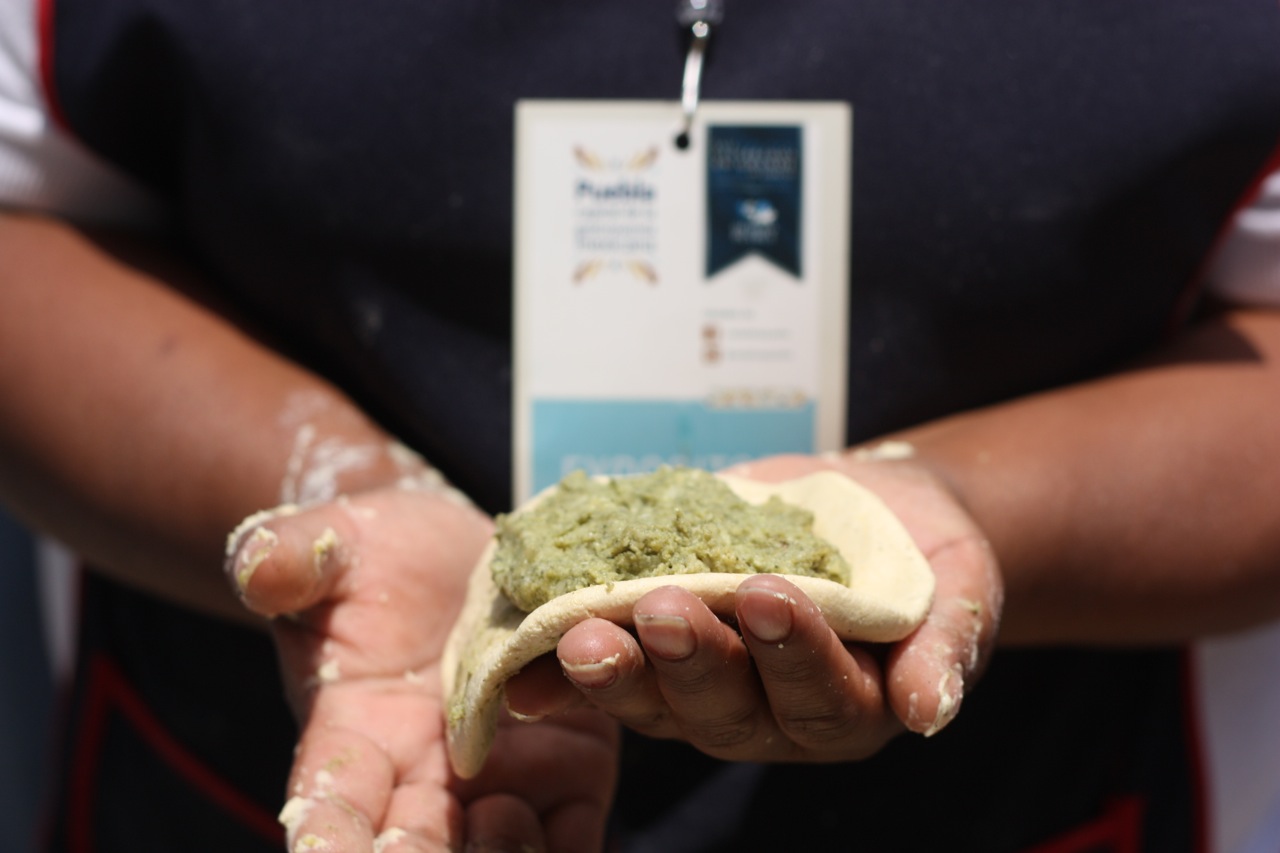
Kneading masa by hand for tlayoyos, a type of tlacoyo from Tlatlauqui, Puebla

A tlayoyo filled with beans (alberjón) and ground-up avocado leaf

The taste of this baby, cooked until crisp on a clay comal, made me want to drive 2 hours to Tlatlauqui to eat more.

Frying up molotes -- a masa fritter typical of Puebla -- on a wood-fired grill.

A molote with a drizzle of chilayo, a type of Pueblan mole. This one came from Yohualichan, northeast of Puebla city.

Some of Puebla's famous cheese-filled breads.

Pan de Zacatlán

The Mole Festival ends today, with another tasting (is it possible to top yesterday?) and talks from various Poblano and Mexico City chefs and researchers.

I’ve already made my plans to go back to some of the smaller towns, and eat my way through them.

Filed Under: Travel Tagged With: mole, Puebla

Primary Sidebar

Who is Mija?


Mija is Lesley Téllez, a writer, mom, and culinary entrepreneur in New York City. I lived in Mexico City for four years, which cemented my deep love for Mexican food and culture. I'm currently the owner/operator of the top-rated tourism company Eat Mexico. I also wrote the cookbook Eat Mexico: Recipes from Mexico City's Streets, Markets & Fondas.

Search this site

Buy My Book On Amazon

Eat Mexico by Lesley Tellez

Get The Mija Chronicles in your inbox

Enter your email address:

Delivered by FeedBurner

Read my old posts

Copyright © 2026 · Foodie Pro & The Genesis Framework